


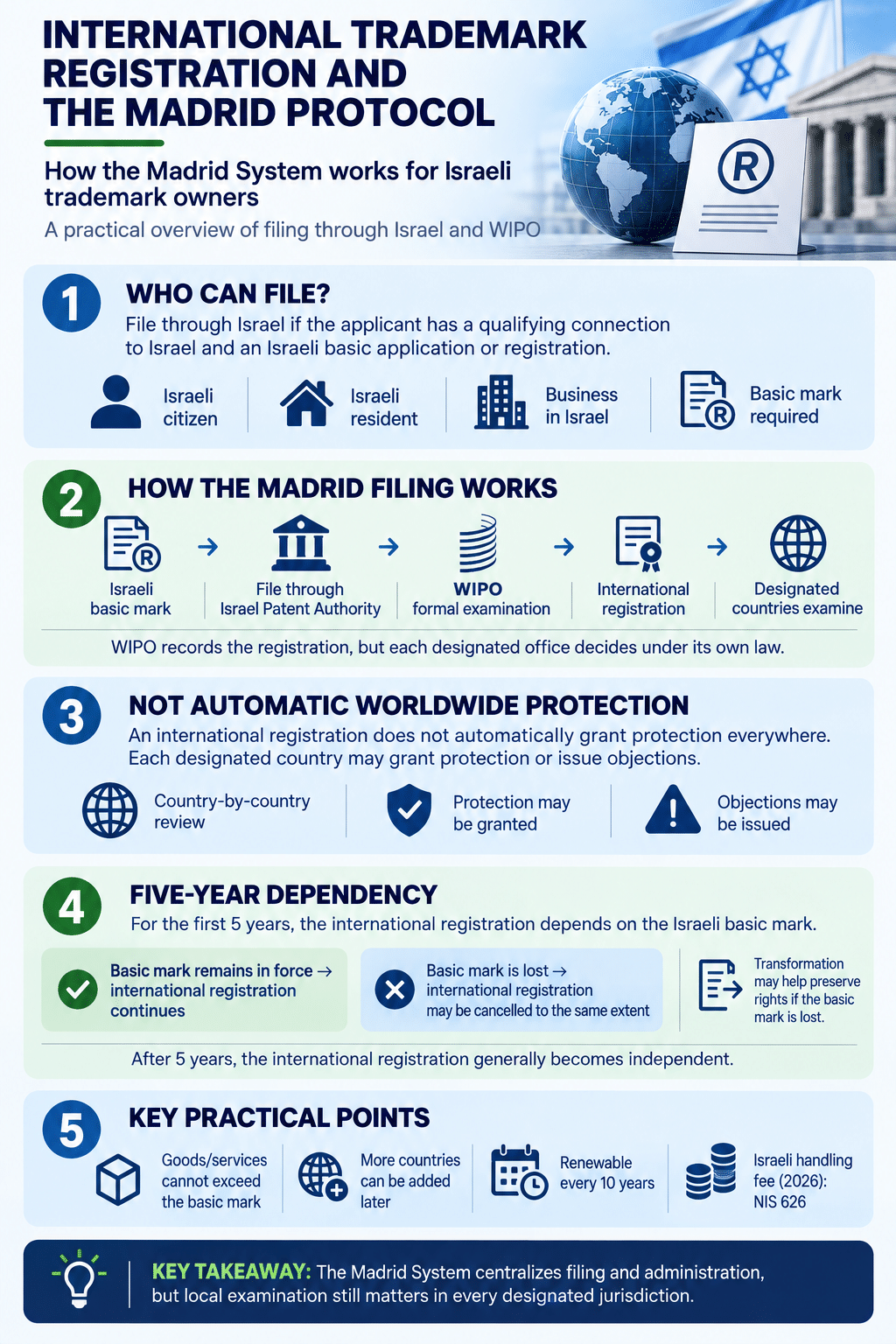
 The Madrid System allows an eligible trademark owner to seek protection in multiple member jurisdictions through a single international application administered by the World Intellectual Property Organization (WIPO). For Israeli applicants, the international application may be based on an existing Israeli trademark application or registration and is filed through the Israel Patent Authority as the Office of origin.
The Madrid route can simplify international filing and portfolio administration, but it does not create a single worldwide trademark. Each designated country or region applies its own trademark law when deciding whether protection will be granted.
For Israeli national filing and prosecution, see our Trademark Registration Process in Israel guide. For Israeli local counsel services, see our Trademark Registration and Prosecution in Israel page.
Who Can File a Madrid Application Through Israel?
The Israel Patent Authority currently permits an international application through the Israeli Office of origin where the applicant has the required connection to Israel and owns an Israeli basic application or registration.
According to the Authority’s current service requirements, the applicant must be an Israeli citizen, an Israeli resident, or have a real and effective industrial or commercial establishment in Israel.
The international application must be based on an existing Israeli national trademark application or registration, commonly called the basic mark.
How the Madrid Filing Process Works
The international application is prepared for the jurisdictions in which protection is requested and is submitted through the Office of origin. The Israeli Office checks that the international application corresponds to the particulars of the Israeli basic mark, certifies the application and forwards it to WIPO.
WIPO then carries out a formal examination. It checks matters such as applicant details, designated Madrid members, the representation of the mark, classification and payment of the international fees.
If the formal requirements are satisfied, WIPO records the mark in the International Register, publishes the registration in the WIPO Gazette and notifies the designated trademark offices.
WIPO Registration Is Not Automatic Protection in Every Country
An international registration at WIPO does not mean that the mark has automatically been substantively approved in every designated country.
Each designated trademark office examines the designation under its own domestic law. A designated office may grant protection, issue a provisional refusal or require a response to objections before protection is confirmed.
Where Israel is designated in an international registration, the Trademarks Department of the Israel Patent Authority examines the designation under Israeli trademark law in substantially the same manner as an Israeli national application.
If an Israeli provisional refusal or other examination objection is issued, see Trademark Examination and Office Actions in Israel.
The Five-Year Dependency on the Basic Mark
For the first five years from the date of the international registration, the international registration is dependent on the Israeli basic application or registration.
If the basic mark is rejected, withdrawn, cancelled, revoked, invalidated or otherwise ceases to have effect during that dependency period, the international registration may be cancelled to the corresponding extent in the designated jurisdictions. The same consequence can arise from proceedings commenced during the five-year period even if the final loss of the basic mark occurs later.
After the five-year dependency period expires, the international registration generally becomes independent of the basic mark.
Transformation After Loss of the Basic Mark
The Madrid Protocol contains a mechanism known as transformation that may preserve rights when an international registration is cancelled because the basic mark ceased to have effect during the dependency period.
Subject to the applicable conditions, the holder may file national or regional applications in the affected designated jurisdictions within three months of the relevant cancellation of the international registration. Those applications may retain the international registration date or applicable subsequent-designation date.
Transformation can be important because it may preserve filing priority, but it converts the affected protection into separate national or regional applications and therefore removes much of the centralized administrative benefit of the Madrid System.
Madrid Application vs. Direct National Filing
The Madrid System and direct national filing are alternative routes, and neither is automatically preferable in every case.
The Madrid route can centralize filing, renewal and certain recordal changes, particularly where protection is sought in multiple member jurisdictions. Direct national filing may be preferable where only a small number of countries are relevant, where a particular jurisdiction requires a filing strategy that differs from the basic mark, or where the five-year dependency on the basic mark presents a material risk.
A Madrid filing may reduce administrative duplication, but applicants should not assume that it eliminates all local costs. If a designated office issues a provisional refusal or a contentious matter arises, local counsel may still be required in that jurisdiction.
Goods and Services in an International Application
The goods and services in the international application must remain within the scope of the goods and services covered by the basic application or registration. The international application cannot be used to expand the scope beyond the basic mark.
The wording and classification should therefore be reviewed before the international application is filed, especially where the applicant plans to designate multiple jurisdictions with different examination practices.
Subsequent Designations
An international registration can later be extended to additional Madrid System members through a subsequent designation, subject to the applicable WIPO requirements and fees.
This allows a trademark owner to expand the geographic scope of an existing international registration as its business enters additional markets.
Renewal and Centralized Portfolio Management
An international registration is registered for a period of 10 years and may be renewed for further 10-year periods through WIPO.
The Madrid System also centralizes certain portfolio changes, such as renewal and qualifying changes to ownership or holder details, rather than requiring separate recordals in every designated jurisdiction.
Fees for an International Trademark Application from Israel
The total cost includes the Israeli Office-of-origin handling fee and the international fees payable to WIPO. WIPO fees depend on factors such as the designated jurisdictions, the number of classes and whether individual fees apply in particular countries.
Under the Israel Patent Authority’s 2026 fee schedule, the Israeli handling fee for transmitting an international application is NIS 626.
For additional cost information, see Trademark Registration Cost in Israel.
Madrid Applications Designating Israel
Foreign applicants may designate Israel through the Madrid System. Once WIPO notifies Israel of the designation, the Israel Patent Authority examines the request for protection under Israeli trademark law.
If the Authority raises an objection, the holder may need to appoint Israeli counsel and respond within the applicable deadline. We represent foreign trademark attorneys and international registration holders in Israeli provisional refusals, examination responses and related proceedings.
Official Madrid System Resources
Current Israeli filing instructions are available from the Israel Patent Authority’s official international trademark registration service. WIPO provides current Madrid filing guidance through its official international trademark application guidance.
