


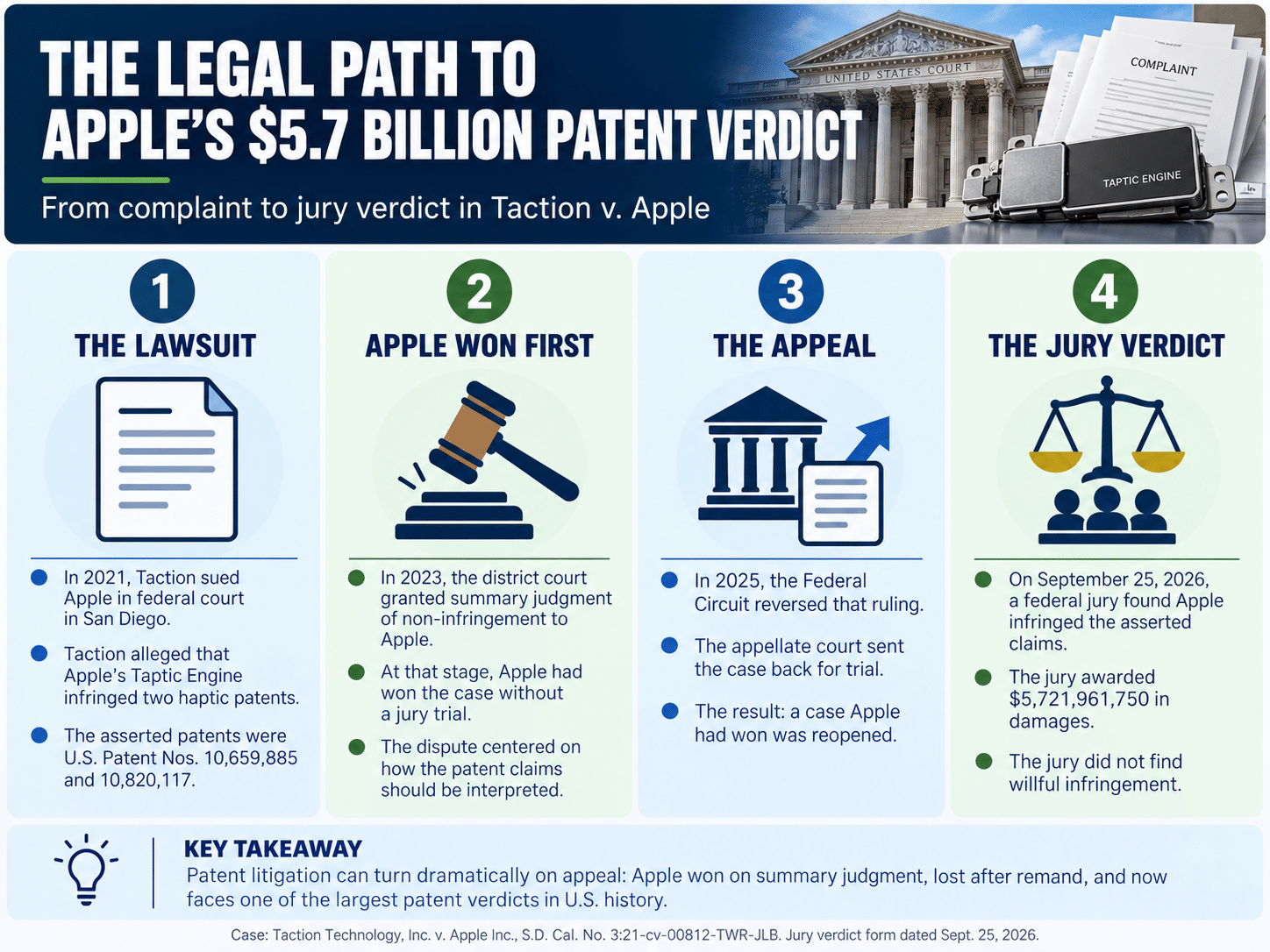
 Patent infringement can cost even the world’s largest companies billions of dollars. In September 2026, a federal jury in California found that Apple infringed two patents owned by Taction Technology relating to vibration and tactile-feedback technology, and awarded Taction $5,721,961,750 in damages. The products at issue include iPhone and Apple Watch devices incorporating Apple’s Taptic Engine. Apple stated that it disagrees with the verdict and intends to appeal.
It is important to emphasize that, at this stage, this is a jury verdict, not the final conclusion of the litigation. The damages award may still change through post-trial motions or on appeal. The full jury verdict form is available for review. The jury found infringement of Claims 17 and 19 of U.S. Patent No. 10,659,885 and Claim 16 of U.S. Patent No. 10,820,117, and rejected Apple’s invalidity arguments as to those claims. At the same time, the jury did not find the infringement to be willful.
What Is Behind Taction’s Patents?
The two patents belong to the same patent family and concern mechanisms for generating vibrations that can be perceived through touch. The technology relies, among other things, on a moving mass, magnets, coils, and a suspension system that enables planar motion, together with the use of ferrofluid, a fluid with magnetic properties, to damp motion and resonance.
The first patent, U.S. Patent No. 10,659,885, describes, among other things, a mechanism in which ferrofluid in physical contact with the moving portion reduces mechanical resonance within a frequency range of 40 to 200 Hz. Claim 17, which the jury found Apple infringed, includes a housing or frame, a coil, magnets, a moving portion, and flexures that guide the motion in a plane, with ferrofluid damping the movement. Claim 19 adds a limitation concerning the shape of the coil.
The second patent, U.S. Patent No. 10,820,117, likewise relates to an electromagnetic mechanism that produces damped planar motion. Claim 16, which was also found infringed, includes a detailed combination of a coil, magnets, a moving mass, flexures having a particular structure, and damping by ferrofluid.
The key point is that these patents do not broadly protect the idea of a “phone that vibrates.” Patent protection is determined by the patent claims, which define a specific combination of components and technical features. To determine patent infringement, the question is whether the accused product satisfies the required elements of the relevant claim.
Apple Actually Won the First Round
One of the most interesting aspects of the case is that, at an earlier stage, it appeared that the lawsuit against Apple had effectively come to an end.
In 2023, the district court granted Apple’s motion for summary judgment and held that there was no patent infringement. The district court’s full decision focused, among other things, on the construction of the term “highly damped output.” The court construed the claims as requiring, among other things, a Q-factor below 1.5, and concluded that, under that construction, infringement by Apple’s products could not be established.
Taction appealed to the U.S. Court of Appeals for the Federal Circuit, the federal appellate court with jurisdiction over patent appeals. In August 2025, the Federal Circuit reversed the outcome, holding that the district court had erred both in excluding part of Taction’s infringement expert testimony and in its construction of the patent claims.
In particular, the Federal Circuit held that there was insufficient basis to limit the claims to a Q-factor below 1.5. As a result, the non-infringement ruling was vacated and the case was remanded to the district court for further proceedings. The full Federal Circuit decision is also available for review.
The practical effect was dramatic: a case that appeared to have ended in Apple’s favor in 2023 returned for trial and, roughly three years later, resulted in a jury verdict exceeding $5.7 billion.
Patent Infringement Does Not Require Copying
The case also illustrates a common misconception about patent infringement. To establish direct infringement, it is not necessary to prove that a company intentionally copied the patent owner’s technology.
Under Section 271 of the U.S. Patent Act, making, using, offering to sell, selling, or importing a patented invention without authorization may constitute infringement.
The central question is: Does the product or process fall within the scope of the patent claims? The question is not whether the company copied the invention or knew in advance that it was infringing.
In other words, one must take the particular patent claim alleged to be infringed, break it down into its constituent elements, and ask whether the accused product satisfies each of those elements. For example, in Apple’s case:

This distinction was also reflected in the Apple verdict. The jury found infringement, but did not find willful infringement. In other words, the absence of a finding of intentional infringement did not prevent the jury from finding that the patents were infringed and awarding damages.
So What Can Companies Really Learn from the Apple Case?
The most important lesson from the case is not merely that “patents can be worth a lot of money.” Rather, it is that the legal test for patent infringement is very different from the way companies sometimes think about the risk. The question is not whether you copied a competitor, but whether your product satisfies every element of a valid patent claim. A company can independently develop a product from scratch and still end up infringing a patent.
For companies developing products, this means that it is not enough to conduct a patent search at the beginning of the development process and then forget about it. As the product changes, features are added, or its architecture evolves, the risk landscape also changes. A Freedom to Operate analysis should focus on the claims of relevant patents and ask, element by element, whether the planned product falls within their scope. If a problem is identified early enough, it may be possible to implement a design-around, obtain a license, or modify the product before launch, rather than face litigation after millions of units have already been sold.
For patent owners, the lesson is the reverse, but no less important: the real value of a patent lies in its claims. An impressive technical description is not enough. The question is whether the claims were drafted so that they cover a competitor’s commercial product without being so broad that they become vulnerable to invalidity challenges.
For further reading, see our article addressing the question: How Should an Independent Patent Claim Be Drafted?
The Taction v. Apple case illustrates this almost perfectly. The dispute was not about the general idea of a “device that vibrates,” but about a defined combination of components inside a relatively small mechanism. Once the jury was persuaded that the Taptic Engine satisfied the elements of the asserted claims, that small component became the focus of a $5.7 billion jury verdict.
And that may be the most important takeaway: in patent law, the difference between a lawful product and an infringing product can sometimes be found not in the big idea, but in a single line of a patent claim.
