


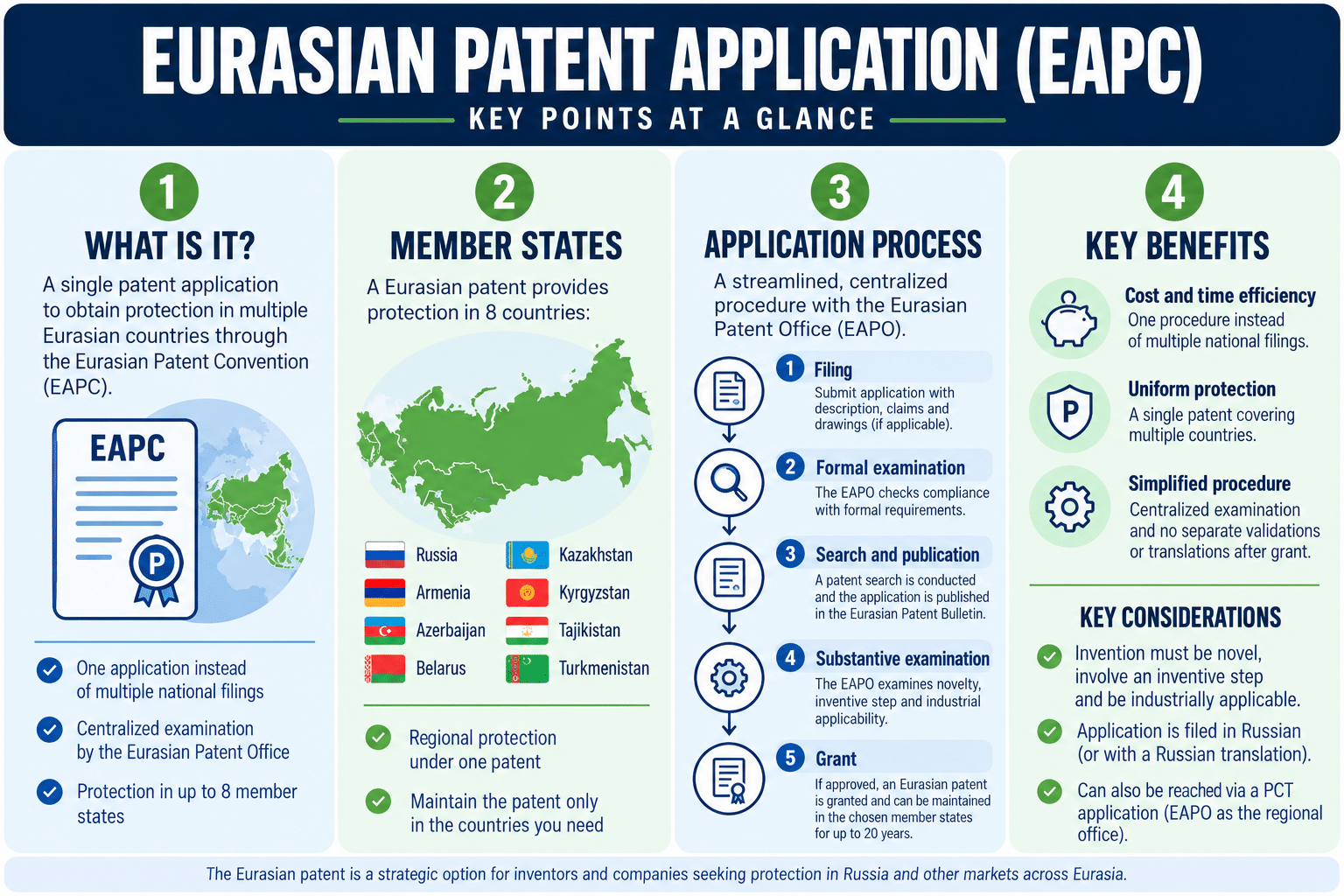
 The Eurasian Patent Convention (EAPC) allows patent applicants to obtain protection for an invention in several countries in the Eurasian region by filing a single regional patent application. Instead of filing and prosecuting a separate patent application in each country, applicants may file a single application with the Eurasian Patent Office (EAPO), which conducts a centralized examination procedure and, if the application is allowed, grants a Eurasian patent.
The Eurasian route is one of the options available as part of a broader strategy for patent registration in Israel and worldwide, and may be particularly relevant to inventors and companies seeking patent protection in Russia and other countries in Central Asia and the Caucasus.
For more information about the process, from filing an application through the grant of a patent, see our guide to the stages of patent registration.
In Which Countries Can Protection Be Obtained Through a Eurasian Patent?
Currently, the Eurasian Patent Convention applies in eight countries: Russia, Armenia, Azerbaijan, Belarus, Kazakhstan, Kyrgyzstan, Tajikistan, and Turkmenistan.
Official and up-to-date information about the member states and the Eurasian patent system is available on the website of the Eurasian Patent Organization.
A granted Eurasian patent may be effective in the member states of the Convention. Thereafter, the patent may be maintained in the countries in which the patent owner wishes to continue protection by paying the applicable maintenance fees.
What Are the Advantages of Filing a Eurasian Patent Application?
The main advantage of the Eurasian route is the ability to conduct a single patent prosecution procedure instead of multiple separate national proceedings. The application is examined centrally by the Eurasian Patent Office, eliminating the need for a separate examination procedure in each member state.
A centralized procedure may reduce the complexity associated with managing multiple patent applications simultaneously and, in appropriate cases, may also reduce costs. Another advantage is that, following the grant of the patent, separate validation procedures and translations into the national languages of each member state are generally not required.
However, the economic advantages of this route depend on the countries in which the applicant actually wishes to obtain protection. Where protection is required in only one country, such as Russia, it may be appropriate to consider whether filing a national patent application would be more suitable.
What Are the Requirements for Obtaining a Eurasian Patent?
To obtain a Eurasian patent, an invention must satisfy the patentability requirements established under the Eurasian Patent Convention.
First, the invention must be novel. This means that, at the relevant date, the invention must not form part of the prior art.
Second, the invention must involve an inventive step, meaning that it must not be obvious to a person skilled in the relevant field in light of the prior art.
Third, the invention must be industrially applicable. In addition, the patent application must describe the invention clearly and sufficiently to enable a person skilled in the art to carry it out.
Before selecting a filing route, it is advisable to consider the overall patent registration strategy, including the countries in which there is a commercial justification for obtaining patent protection.
How Is a Eurasian Patent Application Filed?
A Eurasian patent application generally includes a description of the invention, patent claims defining the scope of protection sought, an abstract, and drawings where necessary to describe the invention.
A Eurasian application may be filed directly. In appropriate cases, the Eurasian route may also be pursued through an international patent application under the PCT, with the Eurasian Patent Office acting as the regional office at the relevant stage.
Detailed information about the Eurasian patent application procedure is available on the official website of the Eurasian Patent Office.
The official language of the Eurasian Patent Office is Russian. An application may be filed in another language, subject to the filing of a Russian translation in accordance with the applicable requirements and deadlines.
How Is a Eurasian Patent Application Examined?
After an application is filed, it undergoes an examination for compliance with formal requirements. A patent search is subsequently conducted and the prior art relevant to the invention is considered.
The Eurasian patent application is published in accordance with the provisions of the Convention. To proceed to substantive examination, a request for substantive examination must be filed and the applicable fee paid within the prescribed period.
During substantive examination, the Eurasian Patent Office considers, among other matters, whether the invention is novel, involves an inventive step, and is industrially applicable. During the examination process, the examiner may raise objections and require amendments or clarifications regarding the application and its patent claims.
If the examination is successfully completed and the application satisfies the requirements of the Convention, a Eurasian patent is granted. Further information about examination and patent grants is available on the website of the Eurasian Patent Office.
How Long Is a Eurasian Patent Valid?
As a general rule, the term of protection for a Eurasian patent for an invention is up to 20 years from the filing date of the patent application, subject to the payment of maintenance fees and other applicable legal requirements.
Following grant, the patent owner may choose the member states in which the patent is to be maintained and pay the applicable maintenance fees accordingly. Information regarding the maintenance of Eurasian patents is available on the EAPO website.
This allows the patent owner to adjust the geographical scope of protection over time in accordance with its commercial needs.
Filing a Eurasian Patent Through a PCT Application
One common route to the Eurasian patent system is through an international patent application under the PCT. This route allows applicants to postpone decisions regarding the countries and regions in which they wish to pursue patent protection and subsequently enter the regional phase before the Eurasian Patent Office.
The Eurasian Patent Office accepts applications filed directly as well as applications entering the Eurasian regional phase through the PCT procedure.
Combining a PCT application with the Eurasian regional phase may be suitable where an applicant initially wishes to preserve options for obtaining protection in multiple jurisdictions and later elects to pursue regional protection in the member states of the Eurasian Patent Convention.
Should You File a Eurasian Patent Application?
The decision whether to use the Eurasian route depends primarily on the markets in which the invention has commercial significance, the countries in which the product is expected to be manufactured or sold, competitors’ activities, and the overall cost of obtaining and maintaining patent protection.
Where protection is commercially important in several member states, a Eurasian patent application may provide an efficient alternative to filing multiple separate national patent applications. Conversely, where protection is required in only one country, it is advisable to compare the Eurasian route with filing a national patent application in that country.
Before filing, it is advisable to consider the overall patent filing and registration strategy, including the possibility of filing a PCT application, the countries in which protection is required, the applicable deadlines, and the anticipated costs of each route.
