


In Civil Case No. 35744-05-11, Hanoch Moshe Arie v. S.M.L. Hatzlacha Ltd. et al. (19 June 2013), Judge Avraham Yaakov of the Central District Court dismissed an infringement action concerning Israeli Patent No. 115247 for a liquid flow controller for bottles.
The Court held that the defendants’ Bfree Plus baby feeding bottles lacked essential elements of the claimed invention and therefore constituted neither literal patent infringement nor infringement of the essence of the invention. The plaintiff was ordered to pay NIS 75,000 in legal costs and attorneys’ fees.
The judgment addresses three significant aspects of Israeli patent litigation: claim construction, the doctrine of equivalents and the rights of third parties who exploit an invention during a period in which the patent has lapsed.
Background of the Patent Infringement Dispute
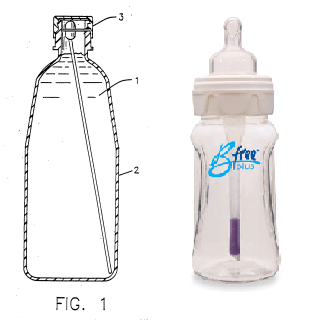
The plaintiff was the owner of Israeli Patent No. 115247, concerning a liquid flow controller for bottles.
The defendants were involved in the manufacture, marketing, distribution and sale of baby feeding bottles marketed under the Bfree Plus brand.
The plaintiff argued that the components of the defendants’ bottles corresponded to the elements of the patent claims and that their commercial activities therefore constituted literal infringement. Alternatively, he argued that the defendants had appropriated the essence of the patented invention.
The defendants maintained that their bottles differed materially from the patented invention in both their components and their manner of operation.
They also raised defenses concerning delay, estoppel and commercial activities undertaken during a period in which the Israeli patent had lapsed due to non-payment of renewal fees.
Delay, Acquiescence and Estoppel in Israeli Patent Litigation
The Court examined the circumstances in which a defendant may rely on delay, acquiescence or estoppel as a defense against intellectual property infringement claims.
In Civil Appeal No. 116/87, Keren Chemicals Ltd. v. Witco Chemicals Ltd., the Israeli Supreme Court addressed the cumulative requirements for establishing such a defense. These include encouragement or representations by the rights holder, reliance upon those representations by the defendant and a detrimental change in the defendant’s position as a result of that reliance.
Although Keren Chemicals concerned registered trademark infringement, the District Court considered these principles applicable to patent disputes as well.
A defendant relying on estoppel must establish that the patent owner, through statements or conduct, consented to the exploitation of the invention. Israeli courts do not readily infer such consent merely from the patent owner’s failure to commence legal proceedings.
Delay and the surrounding circumstances may also affect the amount of compensation awarded if infringement is established.
The distinction is important for international patent owners. Delay in enforcing an Israeli patent does not automatically extinguish the right to bring an infringement action, but representations made to competitors and commercial reliance upon those representations may have significant legal consequences.
Exploitation of an Invention During a Patent Lapse: Section 63 of the Israeli Patents Law
The defendants argued that even if their bottles incorporated the patented invention, they were entitled to continue their commercial activities because they had begun manufacturing, selling or distributing the bottles, or had made substantial preparations to do so, during the period in which the patent was no longer in force.
Israeli Patent No. 115247 had lapsed on 11 March 2002 due to non-payment of renewal fees and was subsequently restored on 15 October 2006.
The plaintiff argued that the defendants had begun exploiting the invention before the patent had lapsed.
Section 63 of the Israeli Patents Law, 5727-1967, protects a person who begins exploiting an invention in Israel, or makes substantial preparations to exploit it, after publication of the patent’s lapse under Section 58. Such a person may continue exploiting the invention for the purposes of their own business even after the patent has been restored.
In Civil Appeal No. 18/75, Lieberman v. Deitelzweig, the Israeli Supreme Court explained the rationale underlying this provision.
A person who establishes a business in reliance upon the lapse of a patent may incur substantial financial expenditure. Requiring that person to discontinue their business following restoration of the patent could impose considerable losses resulting from the patent owner’s failure to maintain the exclusive right granted by law.
The Supreme Court therefore recognized the continued exploitation rights of parties who had commenced manufacturing, distribution and sales during the intervening period, each within the scope of their respective businesses.
In Civil Case No. 1346/07, Abada v. Hagim Nehalim Marketing Ltd. (2 March 2010), the Court also emphasized the significance of good-faith reliance upon the official publication of the patent’s lapse.
Section 64 of the Patents Law further provides that the right of continued exploitation may be transferred, assigned or inherited only together with the business in which the invention was exploited.
These statutory rights are distinct from the right to file an opposition to the restoration of a lapsed patent in Israel.
Application of Section 63 to the Defendants
The evidence established that the third defendant had placed its first order for baby products, including a wide-necked feeding bottle identical to the S.M.L. bottle, on 20 December 2005.
Marketing of the bottles to retail chains commenced in January 2006, before restoration of the Israeli patent.
The Court considered that the commercial activities of the third, fourth and fifth defendants appeared to fall within the protection afforded by Section 63, assuming that patent infringement could otherwise be established.
The position of the first and second defendants was less clear. Their actual sales, marketing and distribution of the new bottle commenced in early 2008, after the patent had been restored.
The Court therefore expressed doubt as to whether these defendants could rely on Section 63.
The action was ultimately dismissed on the separate ground that the accused bottles did not infringe the patent.
For foreign patent owners and litigation counsel, this aspect of the judgment demonstrates the importance of examining the patent’s renewal history and the precise dates on which each defendant commenced commercial exploitation or made substantial preparations for it.
Patent Infringement Under Section 49 of the Israeli Patents Law
Section 49(a) of the Israeli Patents Law entitles a patent owner to prevent unauthorized exploitation of the patented invention, whether in the manner expressly defined in the claims or in a similar manner incorporating the essence of the invention.
Israeli law therefore recognizes two principal forms of patent infringement: literal infringement and infringement of the essence of the invention.
Literal infringement requires the accused product or process to incorporate the elements defined in the relevant patent claim. This principle was considered in Civil Case No. 683/99, Dan Sprinklers Limited Partnership v. Netafim Irrigation Equipment and Drip Systems (18 September 2000).
However, Israeli patent protection is not necessarily confined to the literal wording of the claims.
In Civil Appeal No. 4867/92, Sanitovsky v. Taamas Ltd., PD 50(2) 509, at 516-517, the Israeli Supreme Court explained that patent protection extends to the inventive core of the patented invention.
The essence of the invention consists of those elements that are essential to its operation, as distinguished from components that may be replaced or omitted without materially altering the invention.
An essential component may remain protected where it is replaced by another component performing an equivalent function. This principle is associated with the doctrine of equivalents, originally developed in American patent jurisprudence.
The Doctrine of Equivalents and the Doctrine of Variants
In Civil Appeal No. 345/87, Hughes Aircraft Company v. State of Israel, the Israeli Supreme Court held that substituting an element of a patented invention does not necessarily avoid infringement.
Infringement may still be established where the competing product performs substantially the same function by substantially the same means as those defined in the patent claims.
However, achieving the same result is not sufficient. The manner in which that result is achieved and the means employed must also be substantially equivalent.
The Supreme Court recognized the doctrine of variants and the doctrine of equivalents as tools for determining whether an accused product incorporates the essence of a patented invention.
These principles were also addressed in Civil Appeal No. 407/89, Zuk Or Ltd. v. Car Security Ltd., PD 48(5) 661.
For foreign attorneys familiar with equivalents analysis in other jurisdictions, the Israeli statutory concept of the essence of the invention must be examined in light of the language of Section 49 and the applicable Israeli case law.
Literal Infringement: Comparison of the Patent Claims and the Accused Product
Claim 1 of the patent defined a liquid flow controller intended to produce a uniform flow of liquid from an inverted narrow-necked bottle.
The Court referred to the expert evidence identifying five principal elements of the claimed invention.
Element (a) consisted of a narrow-necked bottle with a small hole in its neck and external threads around the upper portion of the neck.
Element (b) consisted of a disc-shaped peripheral retaining device with a central opening and multiple holes arranged within an annular area. Its outer circumference was attached to the inner wall of the narrow neck of the bottle.
Element (c) consisted of a hollow barrel-like reservoir with an opening at its upper end, when inverted, and a side opening. The reservoir’s outer longitudinal surface was attached to the inner circumference of the central opening in the retaining device.
Element (d) consisted of an air inlet tube positioned perpendicular to the axis of the reservoir. One end was inserted into or connected to the reservoir’s side opening, while the other extended through or connected to the small opening in the neck of the bottle.
Element (e) consisted of a tube inserted at an angle into the opening at the upper end of the reservoir and extending towards the upper end and side of the bottle when inverted.
Having compared these elements with the defendants’ Bfree Plus bottle, the Court identified substantial structural differences.
The accused bottle did not contain the hole in the bottle neck defined in element (a). It also lacked the disc-shaped retaining device with a central opening defined in element (b).
The plaintiff’s expert contended that the accused bottle incorporated the essence of the invention with respect to the reservoir defined in element (c). The comparison also concerned the angled tube defined in element (e).
For literal infringement to be established, all the elements of the relevant claim must be present in the accused product as claimed.
The absence of even one required element was sufficient to defeat the allegation of literal infringement of Claim 1.
Infringement of the Essence of the Invention
The Court next considered whether the defendants’ bottle nevertheless incorporated the essence of the patented invention.
Determining the essence of an invention is ultimately a question of law for the court, rather than a question to be decided by technical experts. Expert evidence may assist the court in understanding the technology, but the interpretation of the patent claims remains a judicial function.
This principle was recognized in Civil Case No. 2051/69, Inteco Establishment v. Spasha.
In Civil Appeal No. 2626/11, Hasin Esh Industries Ltd. v. Cunial Antonio (Israel) Ltd. (11 April 2013), paragraph 35, the Israeli Supreme Court explained that patent interpretation requires consideration of both the language and substance of the patent documents.
The interpretation must also reflect the balance underlying patent law. While patent protection is intended to encourage innovation, an excessively broad interpretation may unjustifiably extend the exclusive commercial rights granted to the patent owner.
The District Court examined the patent claims, the specification, the drawings, the parties’ expert opinions and the accused bottle.
The specification explained that the invention concerned a device attached to a narrow-necked bottle, such as a bottle used for storing carbonated beverages. Narrow-necked bottles are commonly used to limit the escape of gases from such beverages.
The invention was intended to facilitate a smooth and uniform flow of liquid when the bottle was inverted.
The reference to a narrow-necked bottle was therefore not an incidental description. It formed part of the technical context and purpose of the claimed invention.
The Court concluded that the reservoir and the opening in the neck of the bottle were essential to the operation of the invention as defined in Claim 1.
The defendants’ bottle did not incorporate these essential components in the manner required to constitute infringement of the essence of the invention.
The accused bottle also did not employ the particular combination of elements protected by the patent.
Consequently, the defendants’ bottle fell outside the scope of Claim 1 and, accordingly, outside the scope of dependent Claims 2-5.
Claim Construction and the Limits of Patent Protection
The judgment illustrates the relationship between the language of the claims and the protection afforded to the essence of the invention.
Israeli courts do not interpret patent claims in isolation from the specification and drawings. Other parts of the patent may assist in determining the meaning attributed by the inventor to particular technical expressions.
However, the specification cannot be used selectively to expand the scope of protection beyond the invention actually claimed.
In Zuk Or, the Supreme Court explained that where the language of the claims indicates that the inventor intended to limit the scope of protection to a particular part of the invention, the court must respect that limitation.
Patent claims serve to define the boundary between permitted and prohibited commercial activities. Competitors must be able to determine the scope of the patent owner’s exclusive rights with a reasonable degree of certainty.
The patent owner is therefore responsible for drafting claims that accurately define the intended scope of protection. Ambiguities may, as a general rule, be construed against the inventor.
In the present case, the Court considered that the technical subject matter was not particularly complex and that the patent could have been drafted in terms that avoided the ambiguity in question.
The Court declined to extend protection to a product that achieved a related commercial objective through a materially different combination of technical elements.
Judgment and Practical Implications for Foreign Patent Owners
The District Court dismissed the infringement action in its entirety and ordered the plaintiff to pay the defendants NIS 75,000 in legal costs and attorneys’ fees.
The judgment demonstrates that similarities in commercial purpose or technical results are insufficient, on their own, to establish infringement under Israeli patent law.
When assessing potential infringement, foreign patent attorneys should examine the precise language of the Israeli claims, identify the essential elements of the invention and compare both the structure and operation of the accused product with those elements.
Where the accused product employs alternative components, the analysis must address whether those components perform substantially equivalent functions through substantially equivalent technical means.
The judgment also demonstrates the importance of claim drafting at the prosecution stage. Unnecessarily restrictive technical terminology may subsequently limit the enforceable scope of an Israeli patent, even where the underlying inventive concept might have supported broader protection.
Patent owners should also maintain accurate renewal records. Restoration of a lapsed patent may not eliminate continued exploitation rights acquired by third parties during the lapse period.
For a broader discussion of claim construction, infringement, expert evidence and available remedies, see our guide to patent infringement litigation in Israel for foreign counsel.
Our patent litigation practice in Israel represents international patent owners and defendants in Israeli patent infringement and validity disputes.
Further reading: Yonatan Drori, Patent Law (Perelstein-Ginosar, 2023, in Hebrew).
