

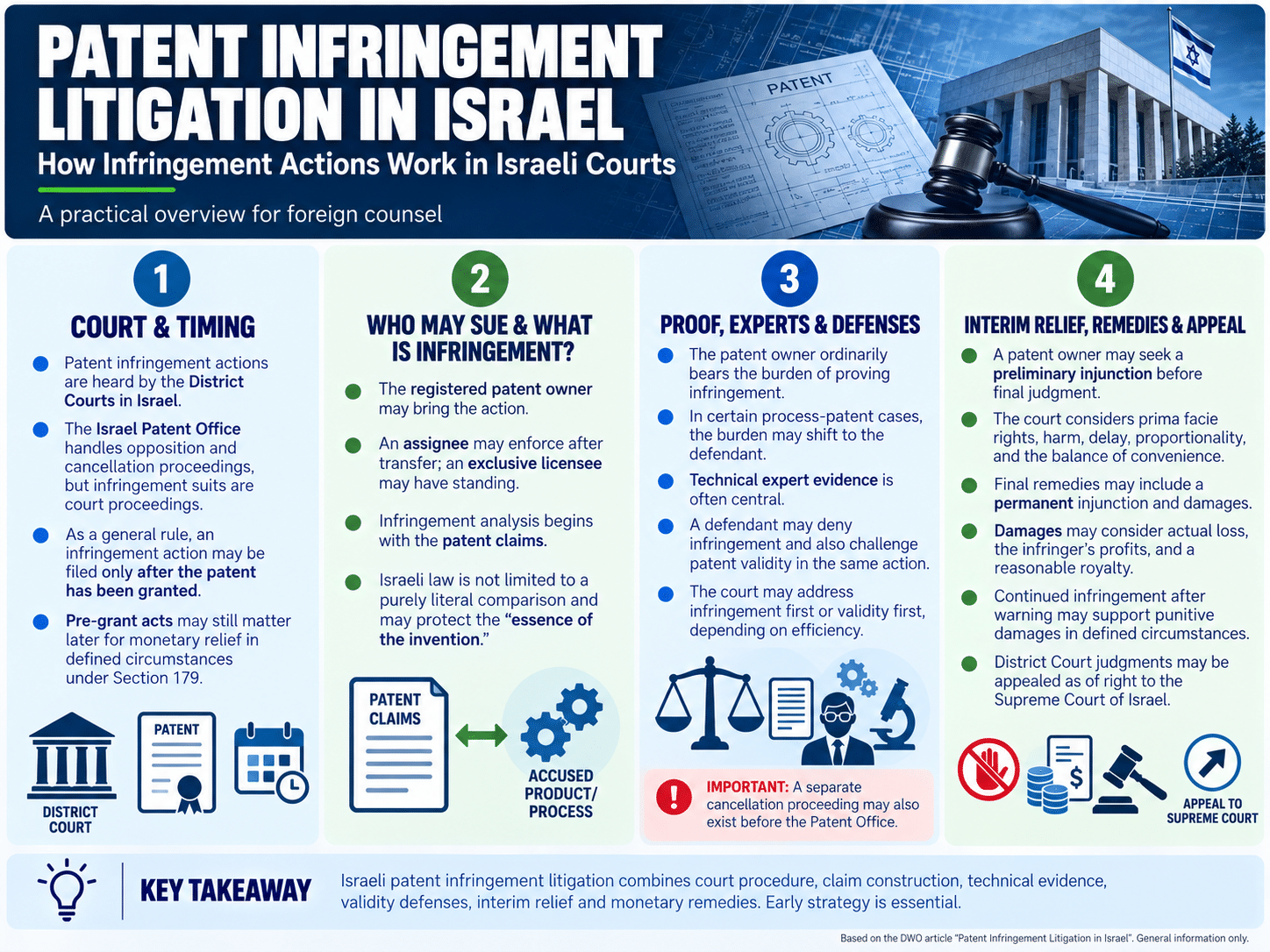
 Patent infringement litigation in Israel is conducted before the Israeli civil courts and may involve questions of claim construction, infringement, patent validity, technical expert evidence, interim injunctions and monetary remedies.
For foreign patent attorneys and litigation counsel, Israeli patent litigation presents several features that are important to identify at an early stage. Patent infringement actions are heard by the District Courts rather than by the Israel Patent Office. Questions concerning infringement and validity may arise in the same court proceeding, while separate opposition or cancellation proceedings may be conducted before the Israel Patent Office. Technical experts frequently play an important role, and proceedings involving the same patent family in the United States, Europe or other jurisdictions may be strategically relevant even though they do not determine the outcome under Israeli law.
Drori Stav IP represents patent owners and defendants in Israeli patent infringement disputes and works with foreign counsel where the Israeli litigation forms part of a broader international enforcement, defense, licensing or settlement strategy.
Where Are Patent Infringement Cases Heard in Israel?
An action for infringement of an Israeli patent is brought before the District Court having jurisdiction over the matter.
The Israel Patent Office has an important adjudicative role in matters such as patent opposition and patent cancellation, but an infringement action seeking relief against an alleged infringer is a court proceeding.
A judgment of the District Court in a patent infringement action may be appealed as of right to the Supreme Court of Israel.
For foreign counsel, this distinction is important. Proceedings before the Israel Patent Office and infringement litigation before the courts may concern overlapping questions of patent validity, claim scope and prior art, but they are procedurally distinct proceedings before different tribunals.
When Can a Patent Infringement Action Be Filed?
As a general rule, an infringement action may be filed only after the Israeli patent has been granted.
Israeli law nevertheless recognizes that certain acts occurring during the period between publication of the patent application and final grant may become relevant after the patent is granted. Section 179 of the Patents Law provides for monetary relief in defined circumstances for qualifying use occurring during the pre-grant period.
The practical distinction is significant. Before grant, the applicant does not yet hold the full proprietary right created by the granted patent and cannot obtain the same range of remedies that is available after grant. Once the patent has been granted, however, earlier qualifying acts may become relevant to the damages analysis under the statutory framework.
Foreign counsel considering enforcement should therefore review not only the date of grant but also the publication history of the Israeli application and the period during which the allegedly infringing activity occurred.
Who May Bring a Patent Infringement Action?
The registered patent owner may bring an infringement action in Israel.
A person to whom the patent has been validly assigned may also enforce the patent once the relevant rights have been transferred. An exclusive licensee may have standing to take action in relation to unauthorized use of the patented invention, subject to the statutory framework governing the relationship between the patent owner and the exclusive licensee.
A non-exclusive licensee does not ordinarily possess the same independent proprietary enforcement right.
Standing should therefore be examined early where the patent is held through a corporate group, has been assigned, is jointly owned or is subject to licensing arrangements. In cross-border disputes, the entity that owns corresponding patents abroad may not necessarily be the entity entitled to enforce the Israeli patent.
What Constitutes Patent Infringement in Israel?
Section 49 of the Israeli Patents Law gives the patent owner the right to prevent unauthorized exploitation of the patented invention.
The infringement analysis begins with the patent claims, but Israeli law does not restrict protection to a purely literal comparison between the wording of the claims and the accused product or process.
An accused product or process may infringe where it falls within the express language of the claims. In appropriate circumstances, infringement may also be established where the accused embodiment takes what Israeli law describes as the “essence of the invention.”
This makes claim construction central to Israeli patent litigation. The court must determine the scope of the protected invention and then compare that scope with the accused product or process.
Foreign counsel should therefore avoid assuming that a modification to one claim element necessarily eliminates infringement. The significance of the modification must be assessed in the context of the claim, the specification and the substance of the patented invention.
Claim Construction and the “Essence of the Invention”
Israeli patent law has developed an approach that protects the invention not only against exact copying of the claim language but also against certain variants that appropriate the substance of the patented invention.
The analysis remains anchored in the claims. The specification and other parts of the patent may assist the court in understanding the meaning and scope of the claimed invention.
This issue often becomes one of the most technically and legally significant parts of the case. A defendant may argue that an omitted, substituted or modified element takes the accused product outside the claim. The patent owner may respond that the modification does not alter the substantive way in which the invention operates and that the accused embodiment nevertheless takes the essence of the invention.
For foreign counsel familiar with doctrines of equivalents in other jurisdictions, the Israeli analysis should be examined on its own terms rather than assumed to be identical to the US, UK or European approach.
Burden of Proof in Patent Infringement Cases
The patent owner ordinarily bears the burden of proving infringement.
That requires the claimant to establish that the defendant has engaged in unauthorized exploitation falling within the protected scope of the patent.
Israeli law contains an important evidentiary rule for certain patented manufacturing processes. Where the statutory conditions are satisfied, the burden may shift to the defendant to establish that an identical product was manufactured by a process different from the patented process.
The process-patent exception can be particularly important where the manufacturing method takes place entirely within the defendant’s facilities and the patent owner cannot reasonably obtain direct evidence of the process used.
For that reason, the evidentiary strategy should be considered before the action is filed. The available product analysis, technical testing, manufacturing information and potential discovery material may determine how the infringement case should be presented.
Patent Office Proceedings as Part of a Litigation Strategy
Patent litigation strategy in Israel is not limited to proceedings before the courts. Depending on the status of the relevant Israeli patent application or granted patent, proceedings before the Israel Patent Office may form an important part of the overall enforcement or defense strategy.
If a patent application has been accepted but has not yet been granted, a third party may consider a Patent Opposition in Israel. If the patent has already been granted, validity may be challenged through Patent Cancellation in Israel.
Where an application is still pending examination, an independent third party may, in appropriate circumstances, seek to accelerate examination. This can move the application more quickly toward refusal or acceptance and reduce the period of uncertainty surrounding the pending claims. See our guide to Third-Party Requests to Expedite Patent Examination in Israel.
These Patent Office proceedings may affect the timing, leverage, validity issues and settlement strategy in an existing or anticipated patent dispute. They should therefore be considered together with any court proceedings. For broader representation in Israeli patent disputes, see Patent Litigation in Israel.
Technical Experts in Israeli Patent Litigation
Expert evidence is frequently central to patent litigation in Israel.
Patent disputes often require the court to determine questions outside ordinary judicial knowledge, particularly in fields such as pharmaceuticals, chemistry, biotechnology, software, electronics, telecommunications, mechanical engineering and medical devices.
The parties may therefore submit expert opinions addressing the technology, interpretation of technical terminology, operation of the accused product or process, prior art and the knowledge of the relevant skilled person.
The court may also have procedural tools available to assist it with technical questions.
For foreign counsel, selection of the expert should be coordinated with the Israeli litigation strategy. An expert report prepared for proceedings in another country may provide useful technical material, but it should not automatically be assumed that the same report, terminology or legal analysis will fit the issues that must be proved under Israeli law.
Can the Defendant Challenge Patent Validity in the Infringement Action?
Yes. Patent validity can become a central defense in an Israeli infringement action.
A defendant may argue that the patent should not have been granted because the claimed invention failed to satisfy the substantive requirements for patent protection. Depending on the case, the challenge may concern novelty, inventive step, sufficiency or other grounds affecting validity.
This creates an important strategic difference between infringement analysis and a simple comparison of products. A defendant may deny infringement and, at the same time, argue that the asserted patent is invalid.
The court may therefore be required to address both infringement and patent validity.
In the ordinary sequence, the court may first consider whether infringement has occurred and then address validity. That sequence is not mandatory. Where validity can efficiently determine the dispute, the court may decide to address the validity issue first.
Patent Cancellation and Invalidity in Court
A post-grant patent may also be attacked through a cancellation proceeding before the Israel Patent Office.
The availability of a Patent Office cancellation proceeding does not mean that validity becomes irrelevant in infringement litigation. A defendant facing an infringement claim may raise validity arguments within the court proceeding, while a separate cancellation proceeding may also exist or be contemplated.
The relationship between the two proceedings should therefore be considered strategically.
In some cases, questions arise as to whether the court proceeding should continue, whether a validity issue should first be determined by the Patent Office, and what effect a decision in one proceeding may have on another.
For a detailed discussion of the administrative post-grant procedure, see our guide to Patent Cancellation in Israel.
Effect of Foreign Patent Proceedings
Foreign proceedings involving the same patent family may be highly relevant to the factual and strategic analysis, but they do not determine the Israeli outcome.
Corresponding patents may have different claim language because of different prosecution histories, amendments, legal standards or commercial decisions made in each jurisdiction.
A rejection, limitation or grant of a corresponding patent abroad therefore does not automatically establish the validity or invalidity of the Israeli patent.
Foreign prosecution history may nevertheless contain important material. Prior art located during US or European prosecution, statements concerning the invention, amendments to corresponding claims and positions taken in foreign litigation may all warrant careful review.
Israeli law has also considered questions analogous to prosecution history estoppel or file wrapper estoppel. Foreign counsel should not assume that the US doctrine applies in Israel in the same manner. The relevance of prosecution history must be examined in the context of Israeli claim interpretation and the particular facts of the case.
This makes coordination particularly important where the same patent family is being litigated or challenged in several jurisdictions.
Preliminary Injunctions in Israeli Patent Cases
A patent owner may seek interim relief before final judgment where continued infringement during the litigation would cause harm that cannot adequately be addressed at the end of the case.
An application for a preliminary injunction requires the court to examine the apparent strength of the claim and the circumstances justifying interim intervention.
The court may consider whether the patent owner has established a prima facie right, whether infringement has been shown at the preliminary stage, the prospects of success in the main action, the nature of the harm, the conduct of the parties and the balance of convenience.
Delay can be important. A patent owner who was aware of the allegedly infringing conduct but waited for a significant period before seeking urgent relief may face difficulty persuading the court that immediate intervention is required.
The court must also consider proportionality and whether another remedy could adequately protect the applicant while causing less harm to the defendant.
Patent preliminary injunction proceedings can be particularly demanding because the court may be required to consider complex questions of infringement and validity at an early stage, before the full evidentiary record has been developed.
The Balance of Convenience
The practical commercial consequences of an interim injunction are often central to the court’s analysis.
The court may compare the harm that the patent owner is expected to suffer if the injunction is refused with the harm that the defendant would suffer if the injunction is granted.
That assessment can involve market structure, loss of exclusivity, price erosion, market entry, customer relationships, the ability to calculate damages later and the commercial consequences of removing the accused product from the market.
A preliminary injunction can sometimes have consequences approaching those of a final judgment. For that reason, the application should be supported by a coherent technical, evidentiary and commercial record from the outset.
Other Interim Measures
Patent litigation may also involve applications for other forms of interim relief where the circumstances justify them.
These may include measures intended to preserve evidence, prevent dissipation of assets or ensure that the final judgment can be effectively enforced.
Whether such relief is appropriate depends heavily on the facts, the evidence available and the urgency of the matter. It should therefore be considered as part of the overall litigation strategy rather than as a routine element of every patent case.
How Does the Court Structure a Patent Infringement Case?
A patent infringement action will generally require the court to deal with infringement, the defenses raised by the defendant and, where liability is established, the appropriate remedies.
The precise sequence is not fixed.
In many cases, infringement will be addressed before validity. In others, the court may consider that determination of validity first would simplify or dispose of the case.
This flexibility is important where infringement analysis would require extensive technical evidence but a threshold validity issue may be capable of determining the dispute more efficiently.
The parties should therefore consider not only which arguments are legally available but also how the case should be structured procedurally.
Permanent Injunctions
An injunction is one of the principal remedies available for patent infringement in Israel.
Where infringement is established, the patent owner may seek an order preventing the defendant from continuing the unauthorized exploitation of the patented invention.
For many patent owners, the injunction is commercially more important than the damages claim. The purpose of the patent is to provide a period of exclusivity, and continued infringement may undermine market position in a way that monetary compensation does not fully repair.
The scope of the injunction should nevertheless correspond to the rights established in the proceeding and the conduct found to infringe.
Damages for Patent Infringement
Section 183 of the Israeli Patents Law provides the principal statutory framework for remedies in infringement actions.
When assessing damages, the court may consider the direct loss suffered by the patent owner, the extent of the infringement, the profits made by the infringer and the reasonable royalties that would have been payable had the infringer obtained a license to exploit the patent.
The statutory factors are not necessarily an exhaustive formula. Patent damages remain highly fact-dependent and may require economic, accounting and industry evidence.
The damages analysis should therefore begin early in the litigation rather than after infringement has already been determined.
Lost Profits and Actual Damage
A patent owner claiming compensation for actual loss must establish the damage caused by the infringement and the necessary causal connection.
That analysis may include lost sales, lost margin and other commercial consequences of the defendant’s conduct.
The calculation can be affected by market competition, the patent owner’s production or sales capacity, the existence of non-infringing alternatives and the extent to which the patented technology contributed to demand for the accused product.
In complex cases, the damages phase may therefore require evidence from economists, accountants or industry experts in addition to the technical patent evidence.
Infringer’s Profits and Accounting
The infringer’s economic benefit may also be relevant to the monetary remedy.
Israeli patent law expressly permits the court to consider profits obtained from the infringement and provides mechanisms relating to an accounting of the extent of infringement.
An accounting can be particularly important where information necessary to quantify the commercial benefit of the infringement is primarily within the defendant’s control.
The existence of infringing sales does not automatically mean that every element of the defendant’s profit is attributable to the patented invention. Causation and the economic contribution of the protected technology may remain important.
Reasonable Royalty
Israeli law expressly recognizes reasonable royalties as a relevant basis for calculating patent infringement damages.
The underlying inquiry considers what royalty would reasonably have been payable had the infringer obtained permission to exploit the patent to the extent of the unauthorized use.
Existing licenses, comparable transactions, the economic significance of the patented technology and the commercial context may be relevant to that analysis.
Reasonable royalty can be particularly important where lost profits are difficult to establish or where the patent owner would not necessarily have made the defendant’s sales itself.
Punitive Damages after Notice of Infringement
Israeli patent law contains a specific provision permitting punitive damages in defined circumstances.
Where infringement continues after the patent owner or exclusive licensee has warned the infringer of the infringement, the court may, in addition to ordinary damages, award punitive damages subject to the statutory limitation.
The remedy is exceptional rather than automatic. The written warning and the defendant’s conduct after receiving it can therefore have important consequences.
For foreign counsel, this makes the drafting and timing of a pre-action infringement notice potentially significant not only for settlement strategy but also for the remedies that may later be sought.
No Automatic US-Style Statutory Damages Regime
Foreign counsel should not assume that Israeli patent law contains a standard statutory damages schedule comparable to remedies available under some other intellectual property regimes.
The principal statutory framework focuses on the actual circumstances of the infringement, the patent owner’s loss, the infringer’s benefit and reasonable royalties.
Israeli case law has addressed circumstances in which precise proof of damage is difficult, but damages strategy should be based on the specific statutory and evidentiary framework applicable to patent infringement rather than on an assumption that a fixed amount can simply be claimed for each act of infringement.
Patent Litigation and Settlement Strategy
Patent litigation frequently operates together with licensing and commercial negotiations.
An infringement action may affect market entry, distribution arrangements, investment decisions, licensing discussions, freedom-to-operate assessments and the value of a broader patent portfolio.
Likewise, a defendant’s invalidity position may become relevant to settlement or licensing negotiations even where the litigation continues.
Where the Israeli dispute is one part of an international conflict, settlement strategy should take account of related patent families, proceedings abroad and the commercial importance of the Israeli market.
Relationship to Patent Opposition
Israeli patent opposition takes place before grant and is therefore fundamentally different from an infringement action based on a granted patent.
Where foreign counsel identifies a potentially problematic Israeli application before grant, it may be possible to challenge the application through an opposition rather than wait for the patent to be granted and later defend an infringement action.
For more information, see Patent Opposition in Israel.
Where the patent has already been granted and a direct post-grant attack is required, see Patent Cancellation in Israel.
Working with Foreign Counsel in Israeli Patent Litigation
Foreign patent attorneys and litigation firms may instruct Drori Stav IP to act as Israeli counsel in patent infringement disputes.
At the beginning of a matter, it is useful for instructing counsel to provide the Israeli patent, the relevant patent family, the accused product or process, available technical material, the Israeli commercial activity at issue and information concerning related proceedings abroad.
Where litigation has already begun in another jurisdiction, relevant pleadings, expert reports, claim construction decisions, prior art analyses and prosecution histories can help identify issues that may also arise in Israel.
We review the Israeli infringement and validity issues, advise on litigation and interim-relief strategy, coordinate technical and expert evidence and conduct the proceeding before the Israeli courts. Where appropriate, we coordinate the Israeli litigation with foreign counsel so that the positions taken in Israel are considered together with the client’s international patent strategy.
Israeli Patent Litigation Counsel
Patent litigation in Israel requires the integration of patent law, civil litigation and technical analysis.
Drori Stav IP combines litigation experience with patent prosecution and technical expertise. This is particularly relevant where claim construction, prosecution history, amendments, prior art and the technical structure of the patent are central to the dispute.
Our lawyers have also authored works on Israeli intellectual property and patent law, including the English-language book Intellectual Property Law in Israel, the book Patent Law and Monetary Remedies in Intellectual Property Procedures.
See our books and publications.
For broader representation in Israeli patent disputes, see our Patent Litigation in Israel page.
For instructions concerning an Israeli patent infringement matter, contact our patent team at office@dwo.co.il.
