

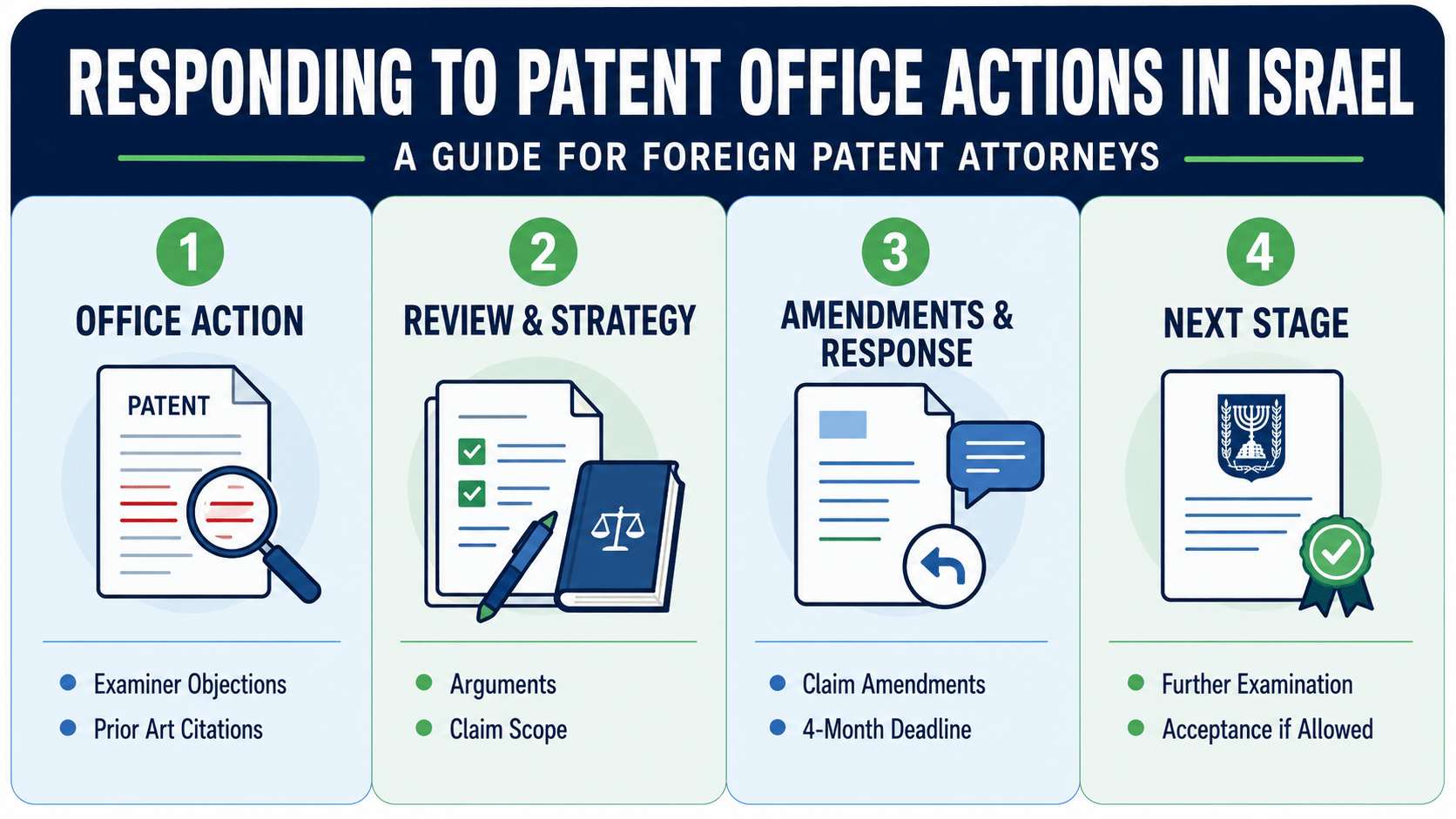
 Receiving an Office Action from the Israel Patent Office requires a timely review of both the examiner’s objections and the prosecution strategy for the Israeli application.
For foreign patent attorneys and IP counsel, the response should not automatically reproduce arguments or amendments used before the USPTO, EPO or another patent office. Israeli patent law and examination practice have their own requirements, including specific rules concerning response deadlines, prior art disclosures and amendments to pending applications.
This guide explains the main issues foreign counsel should consider when instructing a patent attorney in Israel to respond to an Israeli Patent Office Action.
Responding to Office Actions is a core part of our patent prosecution services in Israel, including review of examiner objections, claim amendments and coordination with corresponding foreign prosecution.
For an overview of the entire examination process, see Patent Prosecution in Israel: A Practical Guide for Foreign Counsel.
What Is an Israeli Patent Office Action?
During substantive examination, an examiner may identify grounds on which the invention appears not to be patentable or defects in the patent application.
The Israel Patent Office then issues a written notification identifying the relevant objections.
An Office Action may address issues such as:
lack of novelty; lack of inventive step; patentable subject matter; lack of clarity; insufficient support in the specification; sufficiency of disclosure; unity of invention; prior patent applications or patents; formal defects in the specification or claims; amendments that the examiner considers substantive.
The examiner should identify the grounds for the objection and, where relevant, the prior art relied upon.
Foreign counsel should therefore begin by identifying each objection separately and determining whether it should be addressed through argument, amendment or both.
What Is the Deadline for Responding to an Israeli Patent Office Action?
Under Regulation 42 of the Israeli Patent Regulations, an applicant may respond to a notification of defects issued under Regulation 41 within four months from the date of the notification.
The applicant may use the response to:
correct the identified defects; explain why some or all of the defects do not require correction; request that arguments be heard before the Registrar.
The four-month period is an important distinction from the response periods used by other patent offices. Foreign counsel should therefore rely on the deadline reported for the Israeli application rather than applying a US, European or other foreign prosecution timetable.
Extensions of time may be available under Israeli law in appropriate circumstances. They should not, however, be treated as a substitute for managing the original deadline. Where additional time may be required, foreign counsel should instruct Israeli counsel before the response period expires.
Reviewing the Examiner’s Objections
The first step in preparing a response is to separate the Office Action into its individual objections.
A useful review normally considers three questions:
What is the legal basis of the objection? What prior art or factual material does the examiner rely upon? Can the objection be overcome by argument alone, or should the claims be amended?
Not every objection requires an amendment.
For example, an inventive-step objection may sometimes be addressed by explaining why the cited references do not disclose or suggest the claimed combination. A clarity objection may require only limited changes to the wording of a claim.
In other cases, amendment may provide a more efficient route to allowance.
The appropriate strategy depends on the scope of protection that remains commercially important to the applicant.
Novelty and Inventive Step Objections
Novelty and inventive step are among the most common substantive issues raised during patent examination.
Where the examiner relies on prior art, foreign counsel should review whether the cited reference actually discloses all relevant elements of the claim and whether the examiner’s combination of references supports the inventive-step objection.
A response may address matters such as:
differences between the claimed invention and the cited prior art; technical features omitted from the examiner’s analysis; whether the references can properly be combined; the technical problem addressed by the invention; advantages or technical effects arising from the claimed combination; whether the examiner’s reasoning relies on hindsight.
Where appropriate, the applicant may amend the claims to distinguish the invention more clearly from the cited prior art.
The commercial significance of the proposed amendment should be considered before narrowing the claims. Obtaining allowance is not necessarily useful if the amended claims no longer protect the product, technology or commercial activity that matters to the applicant.
Using Foreign Prosecution Materials
Foreign prosecution can be highly relevant when responding to an Israeli Office Action.
Foreign counsel should consider providing Israeli counsel with:
Office Actions issued by the USPTO, EPO or other patent offices; international search and examination reports; prior art cited abroad; responses submitted in corresponding applications; amended claim sets; notices of allowance; granted foreign claims.
These materials may help identify arguments or amendments that have already succeeded in another jurisdiction.
However, an Israeli response should not simply copy a foreign response.
Israeli patentability requirements and examination practice may differ from those applied abroad. A claim allowed by the USPTO or EPO will not automatically be accepted by the Israel Patent Office.
Foreign prosecution should therefore be used as a strategic resource rather than as a substitute for an analysis under Israeli law.
Section 18 and Prior Art Disclosures
Foreign counsel should also consider whether developments in foreign prosecution create disclosure obligations in Israel.
Under Section 18 of the Israeli Patents Law, the Israel Patent Office may require information concerning prior art and material relied upon during examination of corresponding applications in other jurisdictions.
Accordingly, a new reference cited by the USPTO, EPO or another patent office may need to be brought to the attention of Israeli counsel even if it arises after the Israeli examination process has begun.
Foreign counsel should therefore send Israeli counsel material new search and examination results while the Israeli application remains pending.
The response to an Office Action provides a natural opportunity to review whether the Section 18 record is complete and up to date.
Amending Claims in Response to an Office Action
Israeli law gives applicants considerable flexibility to amend a patent application before acceptance.
An applicant may amend the specification or claims in response to an Office Action. The applicant may also make amendments on its own initiative before acceptance.
This flexibility can be useful when an examiner identifies prior art or another defect that can be addressed through a revised claim set.
However, foreign counsel should pay particular attention to amendments that introduce substantive new matter.
Under Israeli law, a substantive amendment can affect the relevant date attributed to the amended subject matter. In some circumstances, the consequences may extend beyond the particular wording that was added.
The amendment strategy should therefore consider both:
whether the amendment overcomes the examiner’s objection; whether it creates an undesirable consequence for the application’s relevant date.
For a detailed explanation, see Substantial Amendments to a Patent Application Before Acceptance in Israel.
What Happens after the Response Is Filed?
After the applicant files the response, the examiner reviews the arguments and any amendments.
If the response resolves the outstanding objections, the application may proceed toward acceptance.
If the examiner identifies remaining defects, the Israel Patent Office may issue a further notification. The applicant may then need to submit additional arguments or amendments.
Where the examiner considers that the response does not overcome the objections, the application may ultimately be refused.
Israeli procedure also provides mechanisms for requesting that arguments be heard before the Registrar.
If the Registrar refuses the application following the examination process, the applicant may, under the applicable procedural rules, request a hearing within the prescribed period. Israeli law also provides a mechanism for requesting reconsideration of a refusal in certain circumstances.
For the broader process from examination through acceptance and grant, see Patent Prosecution in Israel: A Practical Guide for Foreign Counsel.
What Should Foreign Counsel Send to Israeli Counsel?
When instructing Israeli counsel to respond to an Office Action, foreign patent attorneys should preferably provide:
Israeli patent application number; Foreign associate file reference; The Office Action, if not already available to Israeli counsel; Current commercial objectives for the claims; Corresponding US, EP, PCT or other foreign prosecution materials; Relevant foreign Office Actions and search reports; Current or allowed foreign claim sets; Prior art cited since the previous Israeli report; Any proposed amendments; Instructions concerning arguments already used abroad; Any commercial deadline affecting prosecution strategy.
Foreign counsel should also identify whether maintaining broad claim scope is particularly important or whether obtaining allowance quickly is the principal commercial objective.
This information helps Israeli counsel select a response strategy that addresses both the examiner’s objections and the applicant’s business objectives.
Practical Strategy for Responding to an Israeli Office Action
A well-prepared response should do more than remove the immediate objection.
Foreign counsel and Israeli counsel should consider:
the scope of protection required in Israel; the prosecution history in corresponding jurisdictions; the strength of the examiner’s prior art; whether amendment is necessary; the consequences of any substantive amendment; Section 18 disclosure requirements; the likelihood of further examination; the commercial value of obtaining allowance quickly.
The optimal Israeli strategy may therefore differ from the strategy adopted for the same patent family abroad.
In some cases, consistency across jurisdictions is useful. In others, Israeli law provides an opportunity to maintain different or broader claims.
Costs of Responding to an Israeli Patent Office Action
The cost of a response depends primarily on the complexity of the objections and the work required to address them.
A relatively simple formal objection may require limited work. A substantive novelty or inventive-step rejection involving several prior art references may require detailed legal and technical analysis.
Claim amendments and coordination with extensive foreign prosecution may also affect the cost.
For a broader discussion of patent filing and prosecution expenses, see Patent Filing Costs in Israel: How Much Does It Cost to Register a Patent?.
Israeli Counsel for Patent Office Action Responses
Drori-Stav & Co. represents foreign patent attorneys, law firms, companies and corporate IP departments in patent prosecution before the Israel Patent Office.
Our work includes reviewing Israeli Office Actions, preparing responses, advising on claim amendments, addressing Section 18 matters and coordinating Israeli prosecution with corresponding foreign applications.
Foreign associates may send us the Israeli application number, Office Action, relevant foreign prosecution materials and instructions for review.
For assistance with an Israeli Patent Office Action or for our current associate fee schedule, please contact our patent team.
