


A Fast-Track Route for Protecting Technological Improvements to Products
China is one of the world’s most important markets for the manufacture, development, and commercialization of technological products. For companies and inventors operating in China, manufacturing there, or concerned about product copying in the Chinese market, there is another option worth considering alongside the conventional patent route: a Utility Model patent.
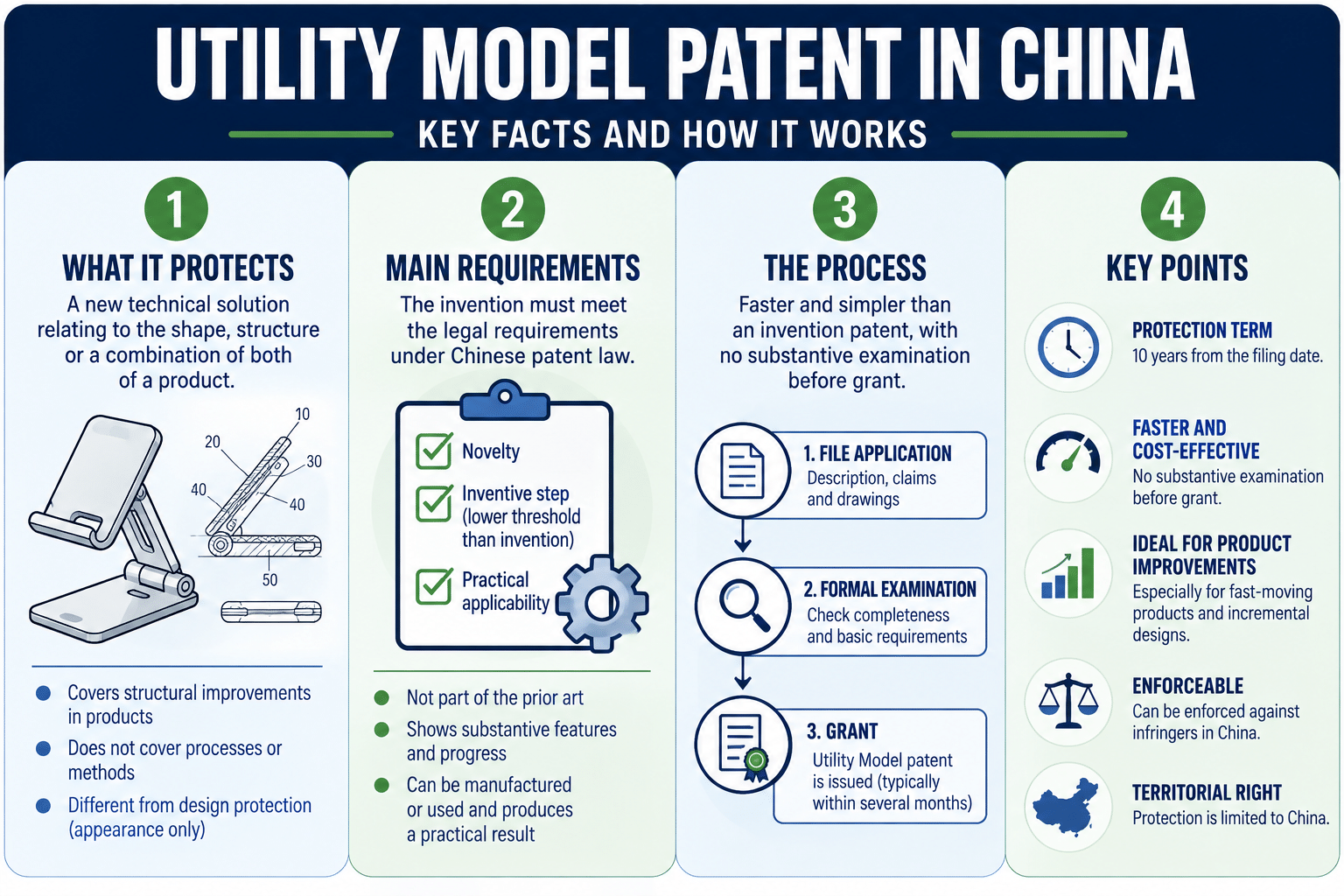
A Utility Model patent can provide protection in China for certain technical solutions relating to the structure or shape of a product. One of its main advantages is that the application does not undergo full substantive examination before the patent is granted. As a result, the right can generally be obtained more quickly than through the Invention Patent route.
However, a Utility Model is not simply a shortened version of a conventional patent. It is a separate form of protection, suitable only for certain types of inventions, with its own requirements and examination procedure.
For more information about assistance with filing patent applications in Israel and abroad, see our page on patent registration.
What Is a Utility Model Patent?
Chinese patent law recognizes three types of patent rights: Invention Patents, Utility Models, and Designs.
A Utility Model is defined under Chinese law as a new technical solution relating to the shape or structure of a product, or a combination of the two, that is fit for practical use.
This means that not every invention is eligible for Utility Model protection. This route is intended primarily for physical products in which the innovation lies in the structure of the product or in the way its components are constructed and interact.
For example, a new locking mechanism for a suitcase, an improved structure for a pipe connector, an innovative hinge for a folding device, a new internal structure for a tool, or a new arrangement of components within a device may, depending on the circumstances, qualify for Utility Model protection.
By contrast, a new manufacturing process, a business method, a software algorithm in itself, or a chemical process will generally not qualify, because the statutory definition relates to a technical solution concerning the shape or structure of a product.
What Are the Requirements for Obtaining a Utility Model in China?
A Utility Model patent must satisfy the requirements of novelty, inventiveness, and practical applicability.
The novelty requirement means that the claimed technical solution must not form part of the prior art available to the public before the filing date of the application.
Utility Models are also subject to an inventive-step requirement, although the threshold under Chinese law is lower than that applicable to an Invention Patent. A Utility Model must possess substantive features and represent progress over the prior art.
Finally, the technical solution must have practical applicability. In other words, it must be capable of being manufactured or used and of producing practical results.
For example, assume that a connector for joining two pipes is already known. A company develops a new internal structure that allows the pipes to be connected and disconnected quickly without tools while reducing the risk of leakage. Such a structural improvement may qualify for Utility Model protection, provided that it satisfies the applicable legal requirements.
By contrast, changing the color of the connector or making a purely aesthetic change to its external appearance would not necessarily justify Utility Model protection and may instead be more appropriately protected through a registered design.
What Is the Difference Between a Utility Model and an Invention Patent?
One of the main differences concerns the examination procedure.
An Invention Patent application may relate to a new technical solution concerning a product, a process, or an improvement to either. Subject to a request for examination, it undergoes substantive examination in which issues such as novelty and inventive step are examined.
A Utility Model application, by contrast, does not undergo the same full substantive examination before grant. It undergoes preliminary examination, and if no grounds for rejection are identified, the patent may be granted.
This does not mean that the application is automatically accepted or that the examination is limited to checking forms. Various requirements applicable to the application may be considered during preliminary examination. Nevertheless, the procedure differs from the substantive examination of an Invention Patent application.
Another important difference concerns the types of inventions that can be protected. While an Invention Patent can also protect processes, a Utility Model is limited to technical solutions relating to the shape or structure of a product.
How Long Does Utility Model Protection Last?
The term of protection for a Utility Model patent in China is 10 years from the filing date.
By comparison, the term of protection for an Invention Patent is 20 years from the filing date.
This difference is not necessarily significant in every industry. Where a product has a relatively short commercial life cycle, such as an electronic accessory or consumer product expected to be replaced by a new model within a few years, obtaining protection quickly may be more important than securing a 20-year term.
Advantages of a Utility Model Patent
The main advantage of a Utility Model is the possibility of obtaining a registered right relatively quickly because the application does not undergo full substantive examination before grant, as an Invention Patent application does.
This speed can have significant commercial value. A company launching a new product cannot always afford to wait several years for the examination of a conventional patent application to be completed, particularly in industries where products are copied quickly or replaced frequently by new models.
Another advantage is that a simpler procedure may also be less expensive. The actual cost will, of course, depend on the complexity of the invention, the scope of the application, translation into Chinese, official fees, and local patent attorney fees.
Utility Models can be particularly useful for protecting structural improvements to existing products. A company manufacturing mechanical equipment, tools, electronic components, accessories, or machine parts may make a series of structural improvements to its products over time. Some of these improvements may be suitable for Utility Model protection.
Example: An Israeli Product Manufactured in China
Assume that an Israeli company develops a new folding smartphone stand and transfers its manufacture to a factory in China.
The distinctive feature of the product is not its external appearance but the structure of its hinge. The hinge incorporates a new arrangement of components that allows the stand to be opened with one hand and fixed at several angles while using fewer parts.
In such a case, filing a Utility Model application in China directed to the mechanical structure of the hinge may be considered.
Such protection can be particularly important when the product itself is manufactured in China. If a manufacturer, subcontractor, or competitor attempts to manufacture a product in China based on the same structural solution, having a Chinese patent right may provide its owner with a local legal enforcement tool.
By contrast, if the principal innovation lies in software that detects the angle of the smartphone and activates a particular function accordingly, a Utility Model would not necessarily be the appropriate route for protecting that software component.
Another Example: Improving an Existing Product
Assume that a manufacturer develops a sports bottle with a new closure mechanism. Push-button bottle caps are already well known, but the new product uses a different arrangement of a valve, spring, and seal that enables the bottle to be opened with a single press while reducing the risk of leakage when carried in a bag.
This is not necessarily an entirely new product. The innovation lies in the structure of an existing mechanism and in the relationship between its components.
This is the type of case in which it may be worthwhile to consider whether a Utility Model can provide effective protection for the structural improvement.
The Main Disadvantage: No Full Substantive Examination Before Grant
The advantage of a faster procedure is also one of its disadvantages.
The fact that a Utility Model has been granted does not necessarily mean that the Chinese patent authority conducted a comprehensive prior-art search before grant and concluded, following full substantive examination, that the technical solution satisfies the novelty and inventive-step requirements.
This can become particularly important when enforcement is contemplated.
Chinese patent law allows a Patent Right Evaluation Report issued by CNIPA to be relied upon in disputes concerning Utility Model infringement. In preparing the report, the patent is searched, analyzed, and evaluated, and the report may serve as evidence in the handling of the dispute.
Accordingly, before relying on a Utility Model to enforce rights against a competitor, it is important to assess the strength of the patent and the relevant prior art rather than relying solely on the fact that the patent was granted.
Is Utility Model Protection Narrower?
Not necessarily.
The fact that the registration procedure is simpler and faster does not mean that the legal scope of protection afforded by a Utility Model is necessarily narrower. As with an Invention Patent, the scope of protection is determined primarily by the patent claims.
The quality of the application and claim drafting is therefore particularly important.
For example, if the innovation in a locking mechanism arises from the structural relationship between three components, a claim that is unnecessarily limited to precise dimensions, a particular material, or a specific shape may allow a competitor to make a relatively minor modification and potentially avoid falling within the scope of the claim.
On the other hand, a claim cannot simply be drafted as broadly as possible. It must be supported by the description and comply with the applicable legal requirements.
For more information, see our article on patent drafting.
Filing a Utility Model and an Invention Patent in Parallel
One interesting feature of Chinese patent law is the possibility of filing both a Utility Model application and an Invention Patent application for the same invention on the same day.
This strategy may allow an applicant to obtain a Utility Model first through the faster route while continuing prosecution of the Invention Patent application.
Chinese law, however, does not permit two valid patent rights to remain in force for the same invention. Where the statutory requirements are satisfied and the Invention Patent application reaches the stage at which a patent can be granted, the Utility Model right may be abandoned in accordance with the mechanism provided by law.
For example, a company that develops a new mechanical mechanism for an irrigation system may wish to obtain a Utility Model as quickly as possible to protect the product in the Chinese market while continuing prosecution of an Invention Patent application that may provide protection for a longer period.
A decision to adopt this strategy should be made in advance because the parallel filing option is subject to the conditions prescribed by Chinese law.
Entering the Utility Model Route Through a PCT Application
A company that has already filed an international patent application under the PCT may also, in appropriate circumstances, enter the Chinese national phase as a Utility Model application.
WIPO’s PCT Applicant’s Guide for China expressly addresses entry into the national phase as a Utility Model application.
Accordingly, when the deadline for entering the Chinese national phase approaches, an Invention Patent should not always be selected automatically. The nature of the invention, the product, the pace of the relevant market, and the need for rapid protection should all be considered.
For more information about the international patent route, see our guide to PCT applications.
Can a Utility Model Be Enforced Against Infringers?
Yes. A Utility Model is an enforceable patent right in China.
For a product protected by a Utility Model patent, Chinese patent law allows the patent owner, subject to the applicable legal provisions, to prevent unauthorized acts such as manufacturing, using, offering for sale, selling, or importing the patented product for production or business purposes.
When assessing infringement, the question is not simply whether the competing product looks similar to the patent owner’s product. The patent claims must be analyzed and their technical features compared with those of the allegedly infringing product.
This distinction is particularly important when comparing Utility Model protection with design protection. A design protects the visual features of a product, whereas a Utility Model protects a technical solution embodied in the shape or structure of the product.
Can a Utility Model Be Invalidated After It Is Granted?
Yes.
The fact that an application has passed preliminary examination and the patent has been granted does not prevent a third party from challenging its validity.
After grant, invalidation proceedings may be initiated on the ground that the patent does not satisfy the requirements prescribed by law. One possible argument, for example, is that the technical solution was not novel on the filing date because an identical product or earlier publication had already disclosed the claimed features.
This is one reason why a professional prior-art search may be valuable before filing even when the chosen route does not involve full substantive examination before grant.
When Should a Utility Model Be Considered in China?
This route is particularly worth considering where the main innovation lies in the physical structure or functional shape of a product, where obtaining a registered right quickly is important, and where China is an important market or the place where the product is manufactured.
It may also be attractive for products with relatively short commercial life cycles or for engineering improvements to existing products.
By contrast, where the core of the invention is a process, manufacturing method, new material, or another solution that is not embodied in the shape or structure of a product, an Invention Patent application should be considered.
Even where both routes are available, the choice should not be based solely on which route is faster or less expensive. The expected commercial life of the product, the risk of copying, the countries in which protection is required, the importance of the Chinese market, and the overall patent portfolio strategy should all be considered.
It is also important to remember that patent rights are territorial. A Utility Model granted in China provides protection in China and does not, by itself, create rights in other countries.
For further information, see the stages of patent registration in Israel and abroad.
Summary
Utility Model patents are an important tool within the Chinese patent system, particularly for inventions in which the innovation is embodied in the shape or structure of a product.
Their principal advantage is the possibility of obtaining a registered right through a procedure that does not involve full substantive examination before grant. On the other hand, the protection period is limited to 10 years, the route is not suitable for every type of invention, and the fact that a patent has been granted does not necessarily mean that it will withstand an invalidity challenge.
In appropriate cases, applicants may also consider combining a Utility Model application with an Invention Patent application or choosing the Utility Model route when entering the Chinese national phase of a PCT application.
The appropriate route should therefore be selected according to the nature of the invention and its commercial objectives as part of a broader intellectual property protection strategy in China.
For further official information, see the Patent Law of China on the CNIPA website and the WIPO PCT Applicant’s Guide for the Chinese national phase.
