

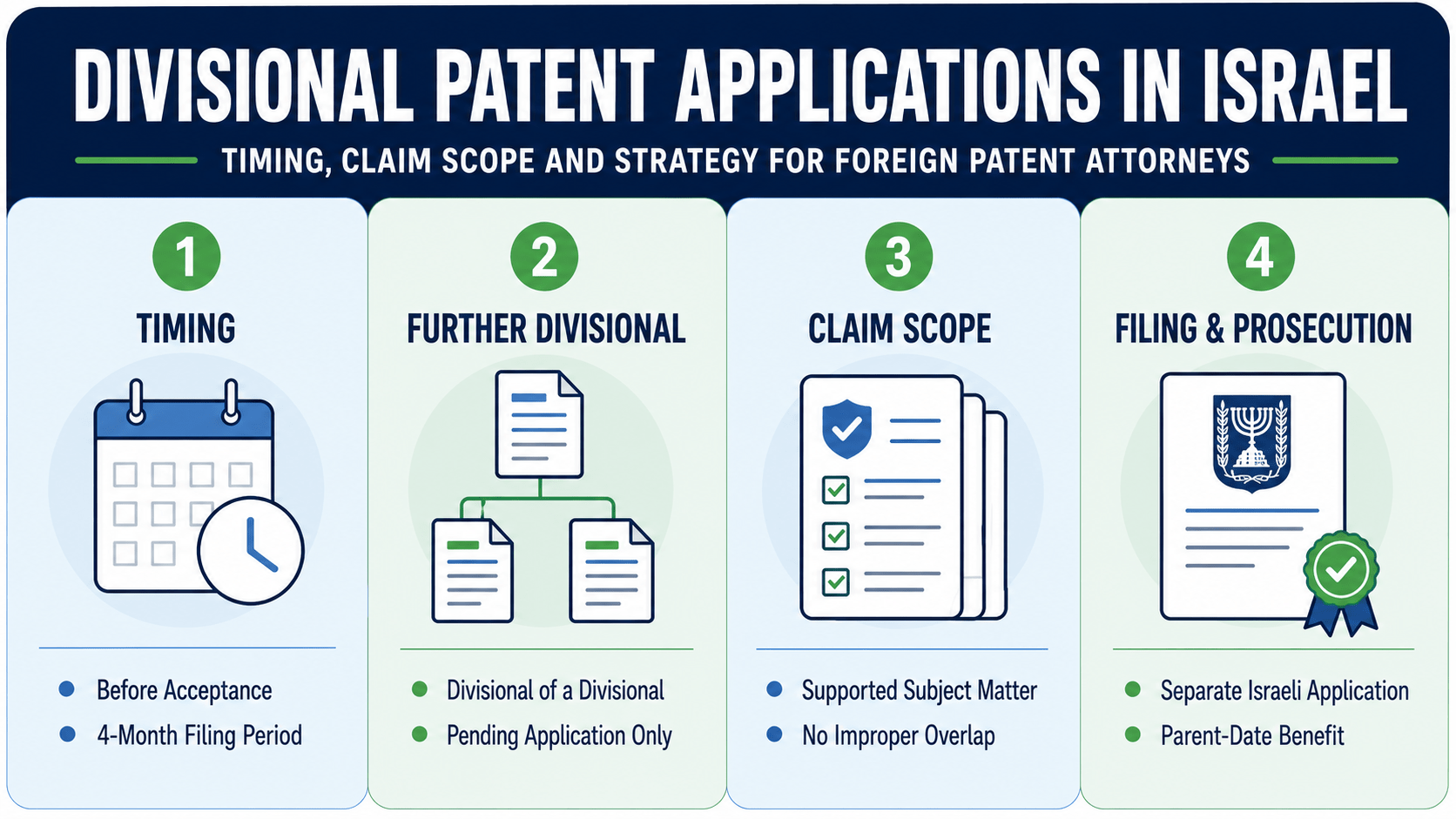
 A divisional patent application allows an applicant to pursue subject matter disclosed in an existing Israeli patent application through a separate application.
For foreign patent attorneys and IP counsel instructing a patent attorney in Israel, the most important issues are timing, preservation of the parent application’s filing and priority dates, support for the divisional claims, and the relationship between the claims of the parent and divisional applications.
Under Israeli law, an applicant may divide a patent application as long as the application to be divided has not yet been accepted.
This guide explains the principal rules and strategic considerations for divisional patent applications in Israel.
Divisional applications are handled as part of our patent filing and prosecution services in Israel, including assessment of timing, claim scope and coordination with the parent application.
For an overview of examination and acceptance in Israel, see Patent Prosecution in Israel: A Practical Guide for Foreign Counsel.
When Can a Divisional Application Be Filed in Israel?
Section 24 of the Israeli Patents Law allows an applicant to divide a patent application while it remains pending and before acceptance.
The Israel Patent Office may also require division where an application contains more than one invention.
The practical deadline is therefore acceptance, rather than grant.
Foreign counsel should consider the need for a divisional application before allowing an application to proceed to acceptance. Once that application has been accepted, it can no longer serve as the application being divided.
This timing issue is particularly important where prosecution has resulted in a narrower claim set but the specification still contains commercially valuable subject matter that the applicant may wish to pursue separately.
Voluntary Division and Lack of Unity
Divisional applications may arise either voluntarily or following an objection from the Israel Patent Office.
Where the examiner determines that an application contains more than one invention, the applicant may need to restrict the claims to one invention and pursue other disclosed inventions in one or more divisional applications.
However, division is not limited to situations involving a formal lack-of-unity objection.
Israeli case law has recognized that separate applications may pursue different patentable aspects arising from the same underlying invention. Examples may include separate protection for a material, a manufacturing process or a particular use, provided that each application independently claims patentable subject matter and the claims are not improperly overlapping.
This gives applicants flexibility to structure protection around different commercially important aspects of the disclosed technology.
Can a Divisional Application Be Further Divided?
Yes.
Israeli practice permits a divisional application to serve as the basis for a further divisional application, provided that the application being divided has not yet been accepted.
In the Genentech matter, the Israel Patent Office recognized the possibility of second-generation and further divisional applications.
Accordingly, the fact that the original parent application has already been accepted does not necessarily end every possibility of further division. If an existing divisional application remains pending and has not been accepted, it may itself be considered for further division.
For foreign counsel managing a complex patent family, this can be an important strategic tool.
The Four-Month Filing Period
Once the applicant informs the Israel Patent Office of the division, or the Registrar orders the application to be divided, the resulting divisional application must be filed within four months.
The divisional is filed as a new and separate patent application.
Foreign counsel should therefore distinguish between:
the requirement that the application being divided must still be unaccepted; the subsequent four-month period for filing the new divisional application after notice or an order to divide.
As a practical matter, it is preferable to determine the proposed claim strategy and confirm support in the parent specification before formally initiating the division process.
Filing Date and Priority of the Divisional Application
A properly filed divisional application generally receives the filing date of the application from which it was divided.
Where the parent application validly claims priority, the divisional may also benefit from that priority to the extent that its subject matter is supported by the relevant priority application.
Preserving the earlier filing and priority dates is one of the principal advantages of a divisional application. It allows the applicant to pursue separately claimed subject matter without treating the divisional as a completely new invention filed on the later divisional filing date.
However, the earlier date does not automatically apply to newly introduced subject matter.
Support in the Parent Application and New Matter
The subject matter pursued in a divisional application should be supported by the application from which it derives.
A divisional application should therefore not be used as a means of introducing new technical disclosure that did not appear in the earlier application.
Israeli law links the divisional filing-date rule to the rules concerning substantive amendments. If the later material amounts to a substantive change, the earlier filing date may not apply to that material.
Foreign counsel should therefore verify that the proposed divisional claims have adequate support in the earlier specification before relying on the parent’s filing or priority date.
For a broader discussion of substantive amendments under Israeli law, see Substantial Amendments to a Patent Application Before Acceptance in Israel.
Can Parent and Divisional Claims Overlap?
This is an important issue in Israeli divisional practice.
The fact that two applications arise from the same disclosure does not prevent them from protecting different aspects of the invention. However, Israeli decisions have emphasized that separate applications should not contain identical or improperly overlapping claims.
In Wellcome, the court recognized that different patentable aspects of the same invention could be pursued in separate applications, provided that each application independently claimed a patentable invention and that the claims were not identical or overlapping.
The issue was considered more strictly in Novartis. There, the Patent Office found that a difference in the breadth of protection alone did not necessarily establish a different invention. Where the parent and divisional claims were found to have substantial identity and complete overlap, the divisional application was refused.
Foreign counsel should therefore examine not only whether the proposed divisional claims are supported by the specification, but also whether they pursue a genuinely distinguishable aspect of the disclosed invention.
This is particularly important when preparing parallel claim sets for the parent and divisional applications.
Strategic Review Before Acceptance
The best time to consider a divisional application is often when the parent application is approaching acceptance.
Before allowing the application to proceed, foreign counsel should ask:
Does the specification disclose commercially important subject matter that is not covered by the claims to be accepted? Were claims deleted or significantly narrowed during examination? Does the application disclose more than one patentable aspect of the technology? Has prosecution abroad identified another valuable claim strategy? Would a separate application provide commercially meaningful additional protection? Are the proposed divisional claims adequately supported by the earlier disclosure? Do the proposed claims improperly overlap with claims remaining in the parent? Is there a pending divisional that could itself support a further divisional?
A review at this stage can preserve options that may otherwise disappear once the relevant application is accepted.
Examination of the Divisional Application
A divisional application is a separate Israeli patent application and requires its own prosecution.
The prosecution of the divisional should nevertheless be coordinated with the parent application and any other related divisional applications.
The examiner may already be familiar with the underlying specification, relevant prior art and prosecution history. Foreign counsel should therefore consider the effect that arguments or amendments in one family member may have on the strategy adopted in another.
For a general explanation of Israeli examination practice, see Patent Prosecution in Israel: A Practical Guide for Foreign Counsel.
If the divisional receives an examination report, see Responding to Patent Office Actions in Israel: A Guide for Foreign Patent Attorneys.
What Should Foreign Counsel Send to Israeli Counsel?
When considering an Israeli divisional application, foreign counsel should preferably provide:
The Israeli application number of the application to be divided; Its current prosecution status; The current claim set; The proposed divisional claims; The portions of the specification supporting those claims; Relevant priority information; Corresponding foreign divisional or continuation claims, where relevant; Relevant foreign examination materials; The commercial objective of the proposed divisional; Instructions concerning the desired relationship between the parent and divisional claims.
If acceptance appears imminent, the divisional issue should be reviewed promptly.
Costs of Filing a Divisional Application in Israel
A divisional application is a separate patent application and therefore involves additional filing and prosecution costs.
The overall cost depends on the complexity of the proposed claims, the work required to prepare the divisional and the subsequent examination process.
For a broader discussion of patent filing and prosecution costs, see Patent Filing Costs in Israel: How Much Does It Cost to Register a Patent?.
Israeli Counsel for Divisional Patent Applications
Drori-Stav & Co. represents foreign patent attorneys, law firms, companies and corporate IP departments in proceedings before the Israel Patent Office.
Our work includes reviewing patent applications before acceptance, advising on divisional filing strategy, preparing divisional applications and coordinating prosecution of parent and divisional patent families.
Foreign associates may send us the Israeli application number, current claims, proposed divisional claims and relevant foreign prosecution materials for review.
For assistance with a divisional patent application in Israel or for our current associate fee schedule, please contact our patent team.
