


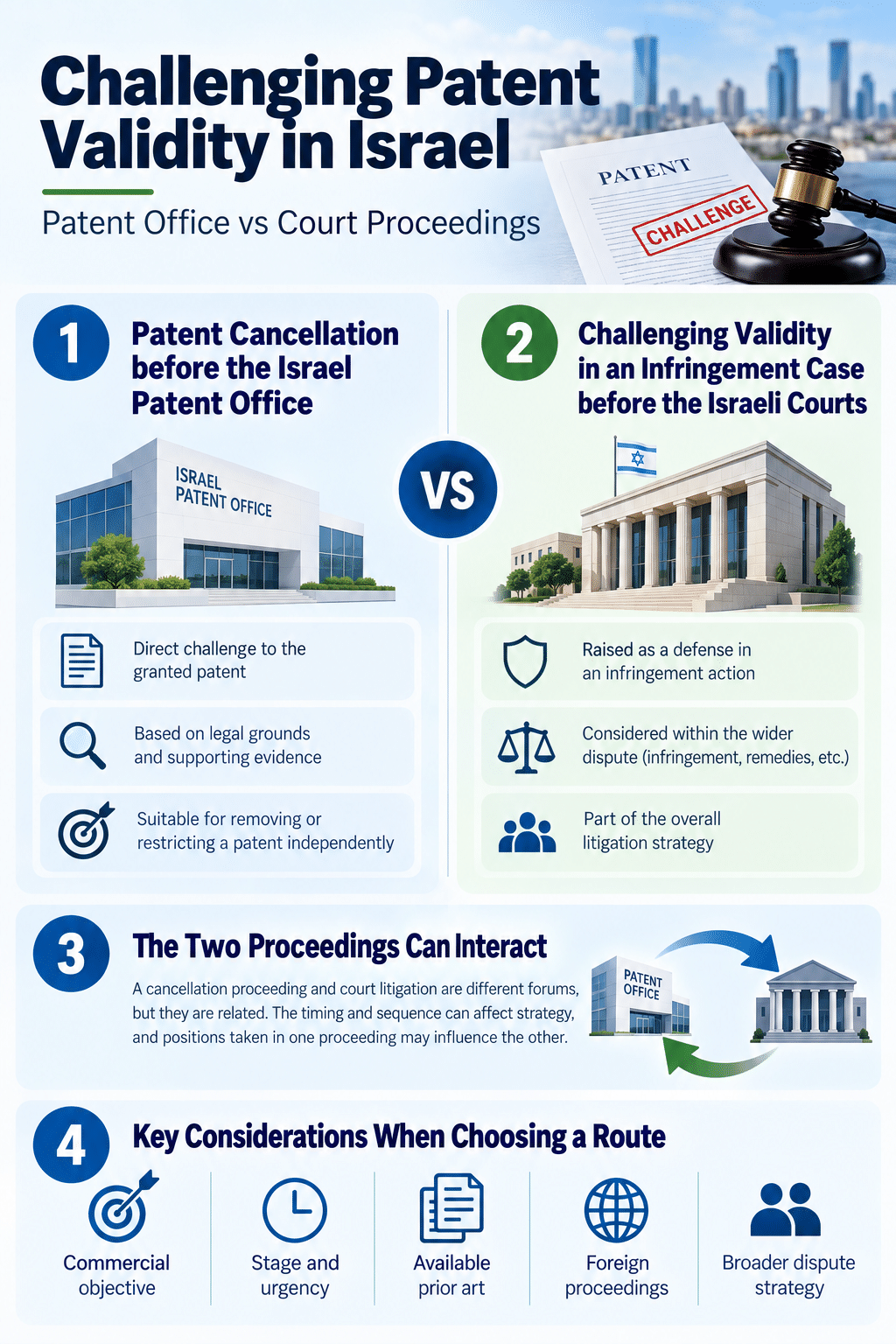
 A granted Israeli patent may be challenged in more than one procedural setting. A party may seek cancellation of the patent before the Israel Patent Office, while patent validity may also become an issue in infringement litigation before the Israeli courts. The two routes are related, but they serve different procedural purposes and can have different strategic consequences.
This article focuses on the relationship between those two routes. For a general guide to the post-grant cancellation procedure itself, including grounds, evidence and the burden of proof, see our Patent Cancellation in Israel guide. For broader court litigation issues, see our Patent Infringement Litigation in Israel guide.
Patent Cancellation before the Israel Patent Office
After an Israeli patent has been granted, an interested party may seek cancellation before the Israel Patent Office. The cancellation proceeding is a direct challenge to the continued validity of the granted patent and is conducted as an adversarial proceeding before the Registrar.
The applicant for cancellation must identify the legal grounds on which the patent should not remain in force and support those grounds with appropriate evidence. Depending on the case, the proceeding may involve prior art, prosecution history, technical documents, factual affidavits and expert opinions.
A cancellation proceeding is particularly relevant where the commercial objective is to remove or restrict a granted patent independently of any pending infringement action. It may also be relevant where a company is planning market entry, licensing negotiations or a broader freedom-to-operate strategy and wishes to address the validity of an Israeli patent directly.
For the detailed procedure, evidentiary framework and distinction from pre-grant opposition, see Patent Cancellation in Israel.
Challenging Patent Validity in an Infringement Case
Patent validity may also arise before an Israeli court when the patent owner brings an infringement action. A defendant accused of infringement may challenge the enforceability or validity of the patent as part of its defense, including by relying on grounds that could have prevented the patent from being granted.
This creates a different procedural setting from a standalone cancellation proceeding. The court is not examining the patent in the abstract. Validity is considered within a dispute concerning alleged infringement, together with claim construction, the accused product or process, technical evidence, remedies and other defenses.
For a defendant, this may make a validity challenge part of the overall infringement strategy rather than a separate objective. For the patent owner, it means that enforcement of the patent can place the validity of the asserted claims under close scrutiny in the same litigation.
Patent Office Cancellation and Court Proceedings Can Interact
The existence of one proceeding does not mean that the other can be ignored. A cancellation proceeding before the Israel Patent Office may be connected with existing or anticipated infringement litigation, and positions taken in one forum can affect strategy in the other.
The timing of the proceedings can therefore be important. If infringement litigation is already pending, foreign counsel should consider whether a separate cancellation proceeding adds procedural or strategic value. If a cancellation request has already been filed and court proceedings later begin, the relationship between the two proceedings should be considered from the outset.
The Israeli court and the Israel Patent Office are different forums with different procedural roles. Decisions about whether to proceed in one forum, both forums or in a particular sequence should therefore be based on the facts of the dispute rather than on a general assumption that one route is always preferable.
Burden of Proof and Procedural Position
The procedural position is also different because a granted patent is already in force. In a standalone cancellation proceeding, the party seeking cancellation bears the burden of establishing a sufficient basis for invalidating the patent.
In infringement litigation, the validity issue arises as part of the defendant’s response to an asserted patent. The litigation record will typically include not only validity evidence but also evidence concerning infringement, claim scope, technical operation of the accused product or process and the remedies sought by the patent owner.
This distinction can affect how the case is prepared. A cancellation case may be built primarily around validity grounds and the technical record relevant to those grounds. An infringement case may require a broader evidentiary strategy because the same patent claims must be considered in the context of both validity and infringement.
Prior Art, Prosecution History and Foreign Proceedings
In both routes, the quality of the technical and documentary record can be decisive. Relevant material may include prior art, the Israeli prosecution history, amendments made during examination, statements concerning claim scope and materials from corresponding foreign applications or proceedings.
Foreign proceedings can be particularly important in cross-border disputes. Search reports, Office Actions, opposition records, invalidity decisions, claim construction materials and expert reports from other jurisdictions may help identify issues that require analysis in Israel.
Foreign decisions are not automatically determinative under Israeli law. The applicable legal standards and procedural context remain Israeli. Nevertheless, consistency between positions taken in Israel and positions taken before the USPTO, EPO or foreign courts can be strategically important.
Choosing the Appropriate Route
The appropriate route depends on the commercial and procedural objective. A company that wishes to remove a blocking patent before any infringement claim has been filed may prefer a direct cancellation strategy. A company that is already defending an infringement action may need to address validity within the court case as part of its defense.
In some matters, the question is not simply which route is legally available, but which route best supports the broader dispute strategy. Relevant considerations may include the stage of the conflict, the claims of commercial concern, available prior art, the expected technical evidence, the urgency of the matter, parallel proceedings abroad and the client’s settlement or licensing objectives.
The decision should therefore be made early, before pleadings and expert positions become fixed in one forum without considering their effect in the other.
Coordination for Foreign Counsel
For foreign patent attorneys and litigation counsel, Israeli validity strategy is often one part of a wider international dispute. The Israeli case may involve a patent family that is also being litigated, opposed or challenged in other jurisdictions.
Instructing counsel should therefore provide the Israeli patent, relevant family members, prosecution records, potentially important prior art and materials from related foreign proceedings. Where infringement litigation is already pending or anticipated, the accused product or process and the positions being taken on claim construction should also be considered.
Coordinating these materials at an early stage can help avoid inconsistent positions and allows the Israeli validity strategy to be developed together with the broader litigation, enforcement or licensing strategy.
Related Israeli Patent Litigation Guides
For the full post-grant procedure before the Israel Patent Office, see Patent Cancellation in Israel. For court proceedings involving infringement, invalidity defenses, injunctions, experts and damages, see Patent Infringement Litigation in Israel: A Guide for Foreign Counsel.
For broader representation in patent disputes, including infringement, cancellation, opposition and appeals, see our Patent Litigation in Israel page.
