


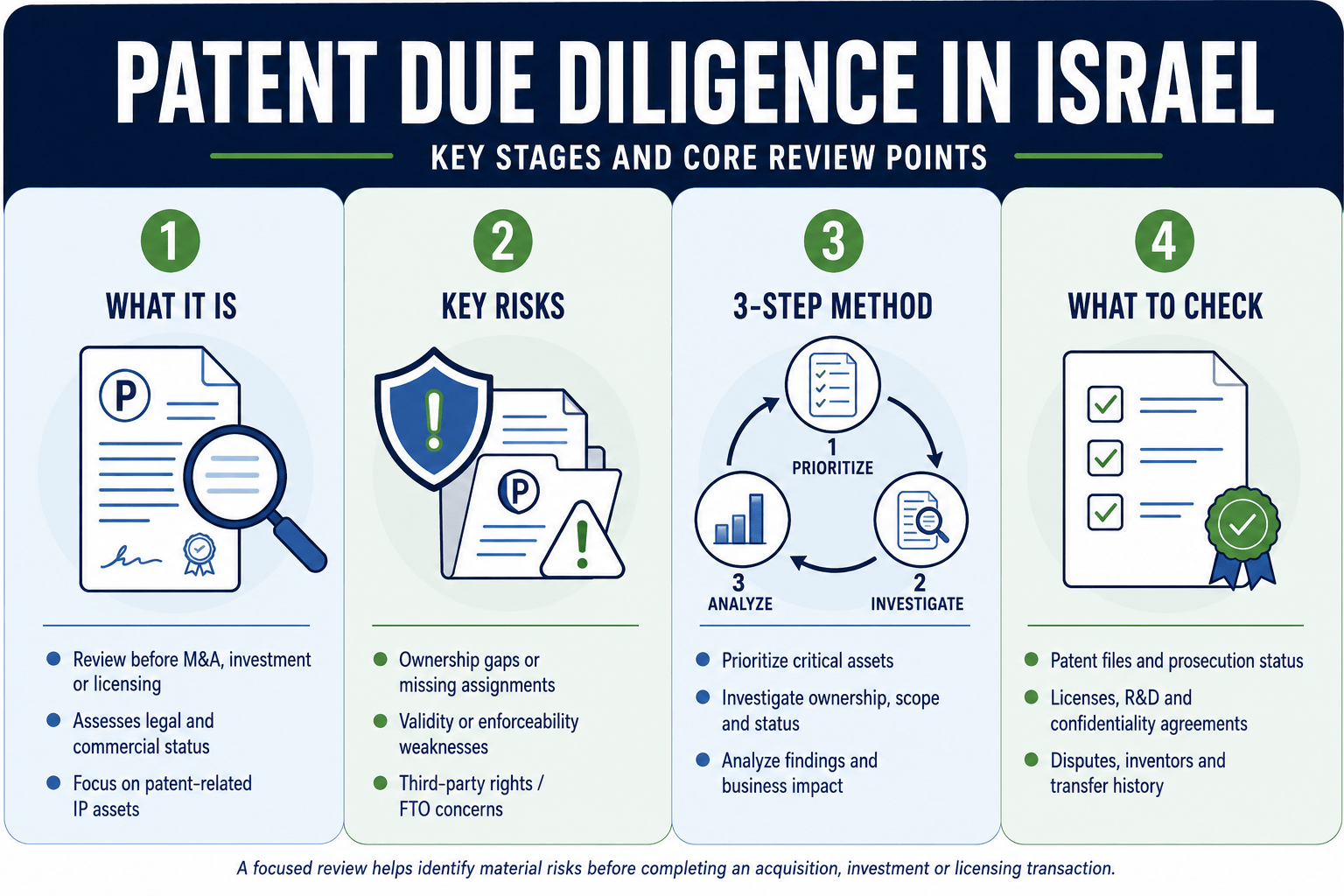
Patent due diligence in Israel is a critical process for companies, investors and acquirers seeking to evaluate patent assets before an acquisition, investment, licensing transaction or technology transfer. The review is designed to identify legal, commercial and ownership risks that may affect the value or structure of the transaction.
Drori-Stav IP provides patent due diligence as part of its broader patent services in Israel, including review of Israeli patent ownership, prosecution status and transaction-related patent risks.
Patents can represent a substantial part of a technology company’s value. However, the existence of registered patents does not necessarily mean that the company owns all relevant rights. It also does not guarantee that the patents are valid and enforceable or that the underlying technology can be commercially exploited without restrictions.
In an Israeli transaction, patent due diligence should examine the ownership and status of Israeli patents and patent applications. The review should also cover assignments and licenses, prosecution history, third-party rights and restrictions that may affect the transfer or use of the relevant technology.
A properly conducted patent due diligence review can identify problems before the transaction is completed, allowing the parties to correct deficiencies, adjust the transaction terms or reconsider the value attributed to the patent portfolio. Patent due diligence is therefore particularly important in mergers and acquisitions, investments, licensing transactions and technology transfers.
For example, in the Albin Trank case, Elbit Systems sold its shares in a company that developed a computerized artificial kidney to Diatronics, declaring that the development did not infringe an existing patent. After the transaction was completed, it was alleged that the development infringed a U.S. patent, resulting in litigation between the parties. The case illustrates why patent-related risks should be identified before a transaction is completed rather than after closing.
What is Patent Due Diligence in Israel?
Patent due diligence in Israel is a structured review of a company’s patent portfolio and related intellectual property rights before a significant commercial transaction. The review may include patent ownership, pending applications, patent prosecution status, validity and enforceability, licenses, assignments and third-party rights. Where Israeli patents or patent applications form part of the transaction, their legal and procedural status should also be examined.
The due diligence process typically takes place after the parties have agreed on the principal commercial terms of a transaction but before closing. A potential buyer or investor may conduct the review to assess the target company’s intellectual property. A company may also conduct due diligence when preparing for a sale, investment, merger, licensing transaction or public offering. In either case, the objective is to identify material risks and determine the legal and commercial value of the relevant intellectual property assets.
What Does a Patent Due Diligence Review Examine?
The scope of the review depends on the nature of the transaction and the importance of the intellectual property involved. In addition to patents and patent applications, an intellectual property due diligence review may include trademarks, registered designs, copyrights, trade secrets and contractual rights relating to technology. Where patents constitute a central part of the transaction, the review should generally be more detailed. It may include ownership, chain of title, prosecution history, scope of protection, remaining patent term and potential patent enforcement issues.
One useful tool in the due diligence process is the preparation of an IP map that identifies the company’s intellectual property assets, their current owners, relevant agreements and their legal status. The IP map can reveal missing assignments, ownership inconsistencies, licensing restrictions or other deficiencies that may need to be addressed before closing. It can also provide a structured basis for negotiations between the parties.
Patent due diligence is particularly important for technology companies whose intellectual property represents a substantial part of their commercial value. Early identification of ownership problems, weaknesses in patent protection, contractual restrictions or third-party rights can reduce transaction risk. It can also influence valuation and allow the parties to address material issues before closing.
Key Risks in Patent Due Diligence in Israel
Failing to conduct patent due diligence can expose both buyers and sellers to significant legal and commercial risks. Problems discovered only after negotiations have advanced may require the parties to reopen agreed terms, delay closing or, in some cases, abandon the transaction entirely.
One of the most important risks concerns ownership. A patent may be jointly owned, subject to an incomplete chain of title, or affected by assignments, licenses or other third-party rights. If these issues are discovered late in the transaction, additional agreements or negotiations may be required and the value attributed to the patent portfolio may be reduced.
Patent validity and enforceability are equally important. A patent that appears valuable may later prove vulnerable because of relevant prior art, prosecution history, limitations in the claims or other legal issues. Where enforcement of the patent is commercially important, the review should also consider potential patent litigation risks.
Examples of Patent Due Diligence Risks
An example illustrating the risks of inadequate due diligence is the Digeo case. The company purchased a patent during a bankruptcy sale without adequately verifying its legal validity. After subsequently filing a patent infringement action, Digeo discovered problems affecting the validity of the patent and was forced to withdraw the lawsuit. The case illustrates the potential consequences of acquiring patent rights without first examining their legal strength.
By contrast, Therakos, a subsidiary of Johnson & Johnson, avoided a potential problem through comprehensive patent due diligence. During negotiations to acquire a patent, its patent attorneys identified amendments that significantly limited the patent and could have affected its usefulness in future enforcement proceedings. The company therefore chose not to proceed with the transaction.
Another example involves Amgen, which acquired patents without being aware of an existing agreement affecting the ability to enforce those patents against certain parties. The agreement later affected Amgen’s ability to obtain preliminary injunctive relief. This illustrates why licenses, settlement agreements, covenants and other contractual restrictions affecting patent rights should be examined before a transaction is completed.
These examples demonstrate why patent due diligence in Israel should examine not only whether patents exist, but also their ownership, validity, enforceability, contractual restrictions and third-party rights. Identifying these issues before closing may affect valuation, transaction structure and even the decision whether to proceed with the deal.
How to Conduct Patent Due Diligence in Israel – The Three-Step Method
Patent due diligence should be proportionate to the importance of the intellectual property involved in the transaction. Where patents are peripheral to the deal, a limited review may be sufficient. Where the patent portfolio represents a substantial part of the company’s value, a more detailed legal and technical investigation will generally be required.
A practical approach is to divide the process into three stages: prioritization, investigation and analysis of results.
Step One: Prioritizing the Relevant Patent Assets
The first step is to identify the patents, patent applications and related intellectual property assets that are most important to the transaction.
The due diligence team should determine which patents protect the company’s principal products, technologies or revenue streams and which assets are most significant to the purchaser, investor or licensee.
Relevant questions may include:
Is the patent portfolio a central or secondary part of the transaction? Which patents protect the company’s core technology or products? Which jurisdictions and markets are commercially important? Is the transaction structured as an acquisition, investment, merger, license or transfer of technology? Are particular patents essential to the economic assumptions underlying the transaction?
The greater the importance of a patent to the transaction, the more detailed the due diligence review should be.
Step Two: Substantive Investigation
The second stage involves a detailed examination of the patent assets identified during the prioritization stage.
The investigation should generally address the following issues:
Ownership and Chain of Title: The review should verify that the company owns the patents and patent applications it claims to own. It should also confirm that inventors, founders, employees and previous owners properly documented all transfers.
Patent Status and Prosecution: The review should examine the current status of relevant patents and pending applications. It should cover prosecution history, outstanding examination issues and the remaining term of protection.
Scope and Validity: The review should examine the patent claims and determine their scope of protection. It should also identify issues that could affect validity or enforceability.
Freedom to Operate: The fact that a company owns a patent does not necessarily mean that it is free to commercialize the underlying product or technology. Relevant third-party patent rights may therefore need to be identified and assessed.
Licenses and Third-Party Rights: Existing licenses, assignments, pledges, settlement agreements, covenants or other contractual rights may restrict the company’s ability to transfer, use or enforce its patents.
Disputes and Proceedings: The review should examine existing or threatened patent disputes. These may include infringement claims, ownership disputes and proceedings affecting validity or enforceability.
For Israeli patents and patent applications, the review should also examine their status and prosecution history under the patent prosecution process in Israel.
Patent Due Diligence Checklist for Israeli Transactions
As part of patent due diligence in Israel, the purchaser, investor or licensee should generally request and review documents relating to:
Patents and Patent Applications – A complete schedule of granted patents and pending applications, including filing, priority, publication, grant and expiration information.
Ownership and Assignments – Documents establishing the chain of title from the inventors to the current owner, including assignments and other transfer documents.
Licenses and Other Rights – Agreements granting or receiving patent licenses, as well as pledges, security interests and other third-party rights.
Patent Prosecution Files – Examination reports, responses, amendments and other relevant correspondence relating to pending applications and granted patents.
Patent Searches and Prior Art – Searches, opinions and other materials relevant to patentability or validity. for more info: The Steps for Registering a Patent in Israel.
Confidentiality and IP Assignment Agreements – Agreements with employees, consultants, contractors, founders and business partners relating to confidentiality and ownership of inventions.
Disputes and Legal Proceedings – Documents concerning patent infringement claims, ownership disputes, validity challenges, settlement agreements and pending or threatened proceedings.
Inventor Information – Invention disclosure records, inventor declarations, publications and documentation confirming the transfer of rights from inventors to the company.
Research and Development Agreements – Agreements with commercial partners, universities, research institutions or other parties that may affect ownership or rights in the technology.
Freedom-to-Operate Materials – Searches, opinions or analyses concerning third-party patents that may restrict commercialization of the relevant products or technology.
The scope of the document request should be tailored to the transaction. A company with a small but strategically important patent portfolio may require a more detailed review than a company with many patents that have little connection to the value of the contemplated deal.
Step Three: Analysis of the Results
The final stage is to assess the legal and commercial significance of the findings.
Not every deficiency has the same impact. The parties may correct some issues before closing. Other issues may require changes to the transaction terms or materially reduce the economic value of the patent portfolio.
The analysis should therefore consider:
Ownership: Are the relevant patents and applications properly owned by the company, and is the chain of title complete?
Patent Strength and Enforceability: Do the claims provide commercially meaningful protection, and are there issues that could affect validity or enforcement?
Licenses and Agreements: Are there contractual obligations or third-party rights that restrict use, transfer or enforcement of the patents?
Pre-Closing Actions: Are assignments, registrations, amendments or other corrective measures required before the transaction closes?
Transaction Terms: Do the findings justify changes to valuation, representations and warranties, indemnification provisions or other transaction terms?
Post-Closing Actions: Are additional patent filings, ownership registrations, prosecution steps or other actions required after closing?
The purpose of the analysis is not merely to identify defects. It is to determine how those defects affect the value, risk profile and structure of the transaction.
A well-structured patent due diligence process allows the purchaser or investor to make an informed decision about whether to proceed with the transaction, renegotiate its terms or require identified problems to be corrected before closing.
Patent Due Diligence vs. Liability and Indemnification
A transaction agreement may include representations, warranties, liability clauses and indemnification provisions relating to patents and other intellectual property. This raises an important question: why conduct patent due diligence if contractual protections are available?
The answer is that contractual protections and patent due diligence serve different purposes.
Representations, warranties and indemnification provisions may provide a remedy after a problem has arisen, but they do not necessarily prevent the problem from affecting the transaction or the acquired business. They may also be subject to financial caps, time limits, procedural requirements and other contractual restrictions.
In addition, financial compensation may not fully address certain intellectual property problems. A patent that is invalid, owned by another party or subject to restrictive rights may have substantially less commercial value regardless of whether the purchaser subsequently has a contractual claim against the seller.
Patent due diligence therefore provides an important additional layer of protection. Its purpose is to identify material risks before closing, when the parties can still correct deficiencies, adjust the purchase price, modify the transaction structure or decide not to proceed.
Conclusion
Patent due diligence in Israel should be tailored to the nature of the transaction, the relevant patent portfolio and the commercial importance of the technology involved.
A focused review of ownership, chain of title, patent status, validity, enforceability, licenses, contractual restrictions and third-party rights can identify material risks before an acquisition, investment, licensing transaction or technology transfer is completed.
For technology-driven transactions, effective patent due diligence can directly influence valuation, negotiation strategy and the ultimate decision whether to proceed with the transaction.
For further details, see my book: Yonatan Drori, Patent Law, Perlstein-Ginosar Publishing, pp. 1443–1459 (2023).
