


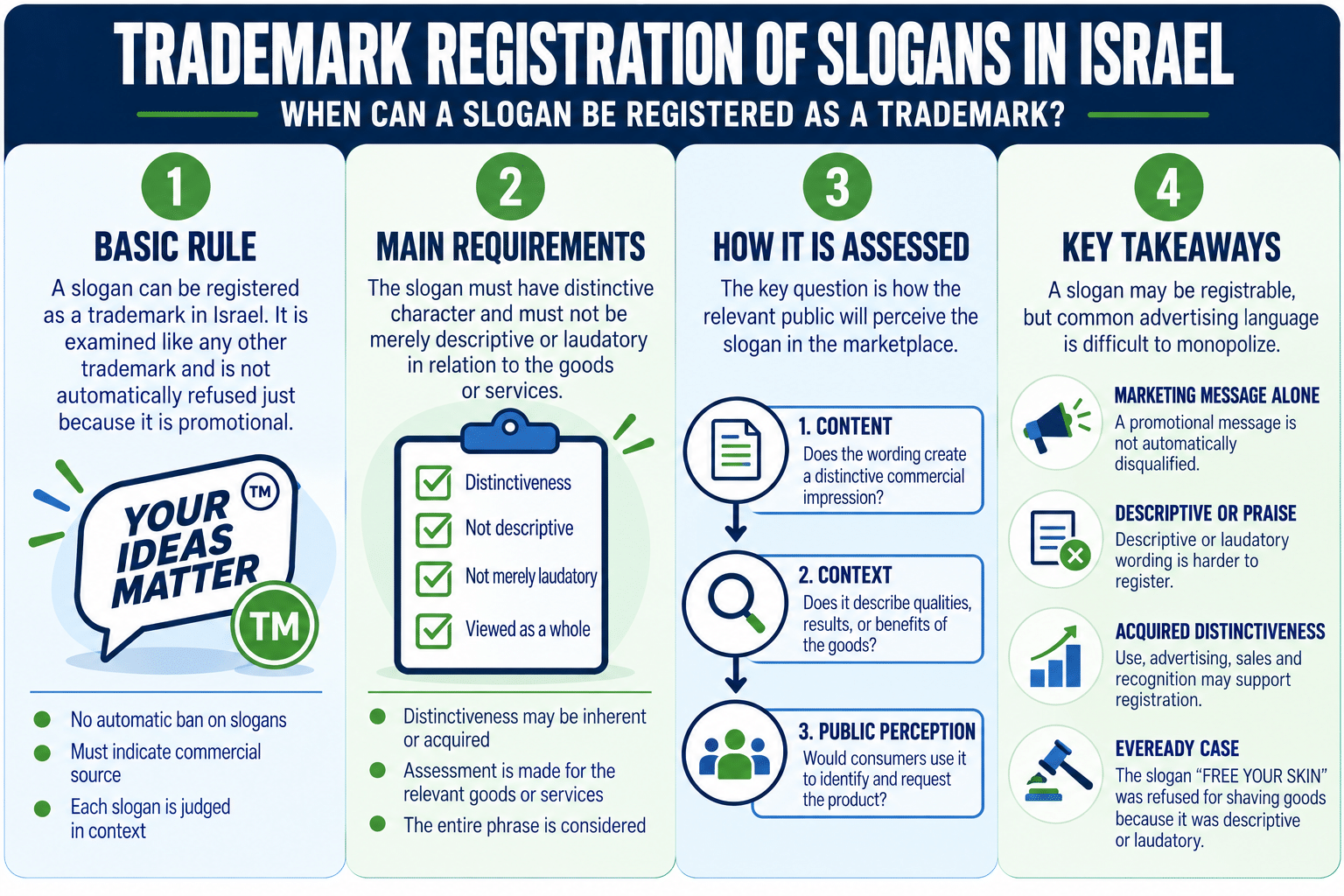
A slogan can be registered as a trademark in Israel. Israeli trademark law does not impose a separate statutory regime for slogans, and a slogan is generally examined under the same principles that apply to other trademarks. The central question is whether the slogan is capable of distinguishing the applicant’s goods or services from those of others and functioning as an indication of commercial origin.
For a concise answer to the threshold question, see Can a Slogan Be Trademarked in Israel?. For the complete Israeli registration procedure, see Trademark Registration Process in Israel.
Can a Slogan Be Registered as a Trademark in Israel?
Yes. There is no rule under Israeli law that automatically prevents the registration of advertising slogans. A slogan may be registered if, when considered as a whole and in relation to the relevant goods or services, it is capable of functioning as a trademark.
The fact that a phrase also conveys an advertising or promotional message does not by itself prevent registration. A slogan may simultaneously promote a product and identify its commercial source. The relevant question is how the phrase is likely to be perceived by the relevant public.
This approach is particularly important for foreign applicants because the Israeli system does not treat a slogan as inherently non-distinctive merely because it is used in advertising.
Distinctiveness and Descriptiveness
The principal requirement is distinctiveness. A slogan must be capable of distinguishing the goods or services of one business from those of others.
Israeli law recognizes both inherent and acquired distinctiveness. An inherently distinctive slogan may be registrable without evidence of extensive prior use. A slogan that does not possess sufficient inherent distinctiveness may, in some circumstances, become registrable if the applicant can establish that the public has come to recognize it as identifying a particular commercial source.
At the same time, descriptive and laudatory expressions face greater difficulty. Expressions that describe the goods, their characteristics or qualities, or consist of ordinary words of praise, may be refused because such wording should generally remain available for use by competitors.
The assessment is always made in relation to the particular goods or services. A phrase that is descriptive for one type of product may be arbitrary or suggestive for another.
Slogans Are Examined as a Whole
Israeli trademark law permits registration of marks consisting of several words. The registrability of a multi-word mark is determined primarily by examining the overall meaning and commercial impression created by the combination.
The individual words may be considered as an analytical aid, but the ultimate question concerns the expression as a whole. Even where individual components have descriptive meanings, their combination may potentially create a new or sufficiently distinctive meaning.
Conversely, merely combining ordinary descriptive or laudatory words will not necessarily produce a registrable trademark.
The current examination practice of the Israel Patent Office also recognizes that a multi-word expression that appears primarily as a marketing message may lack distinctiveness where it is unlikely to be remembered by the public as identifying the applicant and functioning as a trademark.
The Eveready Decision and the Change in Israeli Practice
The leading Israeli decision concerning slogan trademarks is Eveready Battery Company Inc. v. Registrar of Patents, Designs and Trademarks, Civil Appeal 21488-05-11, decided by the Tel Aviv District Court in December 2011.
Before that decision, Israeli examination practice adopted a considerably stricter approach. Registrar Circular M.N. 29, issued in 2004, stated in substance that slogans should generally be regarded as lacking inherent distinctiveness or as directly relating to the nature of the goods, and therefore should normally be registered only after acquiring distinctiveness through use.
The District Court rejected the proposition that slogans should be subjected to such an adverse presumption. It held that the registrability of a slogan should be examined according to the ordinary trademark principles applicable to other signs and that there should be no prior assumption that a slogan is incapable of possessing inherent distinctive character.
Following the decision, the Registrar revoked Circular M.N. 29 in January 2012.
How Will the Israel Patent Office Assess a Slogan?
The central issue is whether the relevant consumer will perceive the slogan as identifying the commercial source of the goods or services rather than merely as an advertising statement.
Relevant factors may include the content of the message, the manner in which it is presented, its language and length, how memorable or catchy it is, the nature of the goods or services and the relevant consumer population.
The Eveready decision also suggested a practical auxiliary test: would a consumer seeking the relevant goods realistically refer to the product by using the slogan when requesting it from a seller?
A positive answer may support the conclusion that the slogan is capable of functioning as a source identifier. However, this is only an aid to the analysis and does not replace the statutory requirements for trademark registration.
The FREE YOUR SKIN Case
In Eveready, the applicant sought registration of the slogan:
FREE YOUR SKIN
The applications covered shaving soaps, shaving preparations and cosmetics in Class 3, and razors and razor blades in Class 8.
The District Court disagreed with the proposition that the slogan lacked distinctiveness simply because it was promotional. The court emphasized that an advertising message can, in principle, also perform a trademark function.
Nevertheless, the appeal ultimately failed. The court concluded that, in relation to shaving products, the expression FREE YOUR SKIN was descriptive or laudatory. The words conveyed the idea that use of the products would leave the consumer’s skin free or clean of facial hair. The combination did not sufficiently alter the ordinary meaning of the individual words or create the kind of new meaning required to make the phrase suggestive rather than descriptive.
The court also considered evidence that similar wording was being used in the cosmetics and personal care fields, supporting the conclusion that the expression should remain available for use by others.
The decision therefore established an important distinction: slogans are not automatically excluded from registration, but a slogan will still be refused if its actual meaning in relation to the goods is descriptive, laudatory or otherwise incapable of functioning as a trademark.
Recent Israeli Practice: The Skechers Slogan Applications
A more recent decision illustrates how these principles continue to be applied.
In February 2025, the Israel Patent Office considered four applications filed by Skechers U.S.A. Inc. for slogans relating to footwear:
JUST SLIP IN
GO SLIP IN
COMFORT THAT PERFORMS
COMFORT THAT SCORES
The applications were examined in relation to footwear. The Office considered whether the slogans possessed inherent distinctiveness and whether they had acquired distinctiveness through use.
The decision is particularly relevant to U.S. companies seeking protection in Israel because Skechers relied, among other things, on the fact that the marks had been registered or accepted abroad. The Israeli authority nevertheless conducted its own assessment under Israeli law.
The decision also rejected the argument that an otherwise non-distinctive slogan should become registrable merely because it is normally displayed next to the well-known SKECHERS house mark. The slogan itself must be capable of satisfying the applicable registration requirements.
Does a U.S. or Foreign Trademark Registration Help in Israel?
A foreign registration can be relevant, but it does not automatically guarantee registration in Israel.
Israeli law contains a special provision for trademarks registered in their country of origin, which may in certain circumstances assist a foreign applicant. However, registration may still be refused where the mark lacks distinctive character, consists of descriptive indications, is customary in Israeli trade, conflicts with prior rights in Israel or is likely to deceive the public.
Accordingly, the fact that a slogan is registered with the USPTO, EUIPO or another foreign trademark office should not be treated as conclusive when planning protection in Israel. The wording should also be assessed specifically from the perspective of Israeli trademark law and the Israeli market.
Acquired Distinctiveness Through Use
A slogan that lacks sufficient inherent distinctiveness may still become registrable if it has acquired distinctive character through use.
Relevant evidence may include the duration and extent of use of the slogan in Israel, advertising expenditures, sales figures, the manner in which the slogan has been presented to consumers, market exposure and evidence demonstrating that consumers associate the slogan itself with the applicant.
For foreign brand owners, evidence of worldwide reputation can be useful, but evidence concerning recognition among the relevant Israeli public is particularly important.
Use of the slogan exclusively or predominantly together with a strong house mark may create an evidentiary difficulty. If consumers recognize the source because of the house mark rather than the slogan, the evidence may not establish that the slogan itself has acquired distinctiveness.
Practical Considerations for Foreign Brand Owners
Before filing a slogan trademark application in Israel, it is advisable to consider whether the phrase describes a feature, quality, result or intended purpose of the goods or services; whether it consists principally of ordinary advertising praise; whether competitors are likely to have a legitimate need to use the same or similar wording; whether the combination creates an unusual or memorable commercial impression; and whether there is evidence that consumers in Israel already recognize the slogan as identifying the applicant.
A short, original and distinctive phrase that does not directly describe the relevant goods or their advantages generally has a stronger basis for registration. By contrast, a conventional promise of quality, convenience, performance, speed or other product benefits may be perceived merely as advertising language that should remain available to competitors.
Registering a Slogan Trademark in Israel
Israeli law does not impose a categorical prohibition on the registration of slogans. Since the Eveready decision, the established principle is that slogans should be examined according to the ordinary rules of trademark law without any presumption that they inherently lack distinctiveness.
The decisive question is whether the relevant public is likely to perceive the slogan as a trademark identifying a particular commercial source rather than merely as descriptive or promotional language.
For U.S. and other foreign applicants, this means that a slogan protected abroad may also be registrable in Israel, but foreign registration alone is not sufficient. The slogan should be evaluated specifically under Israeli law, in relation to the relevant goods or services and the way in which Israeli consumers are likely to understand it.
For Israeli filing and prosecution assistance, foreign counsel may instruct our team through our Trademark Registration and Prosecution in Israel service page.
